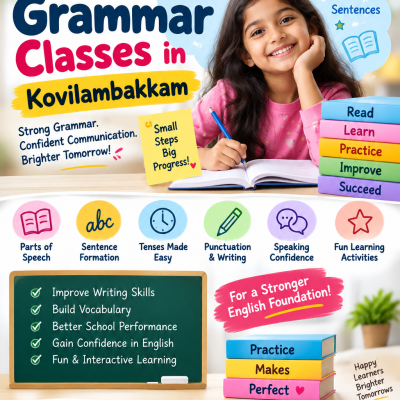


Grammar Classes in Chennai
In today’s competitive world, strong English communication skills can make a meaningful difference in a student’s academic, professional, and personal life. Grammar is one of the most important foundations of effective English. Whether a child is learning basic sentence formation, a school student is preparing for examinations, or an adult wants to communicate more confidently, proper grammar helps make spoken and written English clearer and more accurate.
Finding the right Grammar class in Chennai can provide learners with structured guidance, regular practice, and an environment where they can improve their language skills step by step. A good grammar program does not simply teach rules from a textbook. It helps students understand how grammar works in real conversations, writing, reading, and everyday communication.
Why Grammar Is Important for English Learning
Grammar provides the structure needed to communicate ideas correctly. Words alone are not enough to form meaningful communication. The way words are arranged and connected determines the meaning of a sentence.
For example:
“She is reading a book.”
“She was reading a book.”
“She will read a book.”
The basic idea is similar, but the tense changes the time of the action. Understanding such differences allows students to communicate accurately.
Grammar also helps learners avoid common mistakes in speaking and writing. When children develop a strong grammatical foundation at an early age, they often find it easier to improve vocabulary, reading comprehension, creative writing, and overall communication.
Grammar Classes in Chennai for Different Age Groups
Chennai has learners with different educational backgrounds and language requirements. Therefore, grammar training should not follow a single approach for everyone.
A well-designed Grammar class in Chennai can be adapted according to the learner’s age, current skill level, and learning goals.
Grammar Classes for Kids
Children can start learning basic grammar through simple and enjoyable activities. Instead of memorizing complicated definitions, young learners can understand grammar through stories, pictures, conversations, games, and practical exercises.
Important areas may include:
Alphabet and word recognition
Naming words
Action words
Describing words
Pronouns
Singular and plural
Articles
Basic sentence formation
Simple tenses
Prepositions
Question formation
Everyday vocabulary
Interactive learning can make grammar less intimidating for young children. When lessons are connected with familiar situations, children can understand and remember concepts more effectively.
Grammar Classes for School Students
School students need grammar for both academic performance and everyday communication. English grammar is commonly included in school examinations, assignments, comprehension exercises, and writing activities.
A structured grammar course can help students improve areas such as:
Parts of speech
Nouns and pronouns
Verbs and helping verbs
Adjectives and adverbs
Prepositions
Conjunctions
Articles
Tenses
Subject-verb agreement
Active and passive voice
Direct and indirect speech
Sentence transformation
Question tags
Punctuation
Vocabulary usage
Regular practice is particularly important because students may understand a grammar rule but still make mistakes when using it independently.
Learning Grammar Through Practical Examples
One of the best ways to learn grammar is through practical application.
Instead of only learning the definition of a verb, students can identify verbs in sentences and use them in their own examples.
For instance:
Basic sentence:
“Ravi plays cricket.”
Students can then modify it:
Past tense:
“Ravi played cricket.”
Future tense:
“Ravi will play cricket.”
Present continuous:
“Ravi is playing cricket.”
This type of activity helps learners understand how grammar changes depending on the context.
Understanding Tenses
Tenses are an essential part of English grammar. Many learners find them confusing because English uses different structures to describe actions occurring at different times.
A good grammar program can introduce tenses gradually.
Present Tense
“I go to school every day.”
Past Tense
“I went to school yesterday.”
Future Tense
“I will go to school tomorrow.”
Once students understand the basic concept, they can gradually learn continuous, perfect, and perfect continuous forms.
Practicing tenses through everyday situations can make the learning process easier.
Improving Sentence Formation
Sentence formation is another major component of grammar learning. Some students know many English words but struggle to arrange them correctly.
For example, learners may know the words:
“school,” “go,” “I,” “every day.”
A grammar exercise helps them form:
“I go to school every day.”
With regular practice, students become more comfortable creating sentences independently.
Grammar and Spoken English
Grammar and spoken English are closely connected. While communication does not require every sentence to be perfect, basic grammatical accuracy helps speakers express their thoughts clearly.
Grammar classes can incorporate speaking activities such as:
Self-introduction
Picture description
Storytelling
Question-and-answer sessions
Role play
Group conversations
Daily-life dialogues
Vocabulary games
Short presentations
These activities allow students to apply grammar while speaking rather than learning it only as theory.
Grammar for Better Writing Skills
Strong grammar is particularly useful for writing. Students who understand sentence structure can write paragraphs, essays, letters, stories, and answers more effectively.
Grammar training can help learners understand:
How to begin a sentence
How to connect ideas
Where to use punctuation
How to maintain correct tense
How to avoid repetition
How to create meaningful paragraphs
How to identify and correct grammatical errors
Better grammar can make writing easier to understand and more professional.
Common Grammar Mistakes Students Make
Students learning English often make mistakes because their first language may have a different sentence structure.
Some common examples include:
Incorrect: He go to school every day.
Correct: He goes to school every day.
Incorrect: She have a book.
Correct: She has a book.
Incorrect: I am knowing the answer.
Correct: I know the answer.
Incorrect: They was playing.
Correct: They were playing.
Identifying such mistakes and practicing the correct forms repeatedly can gradually improve accuracy.
Why Regular Practice Matters
Grammar cannot usually be mastered by attending a few classes and memorizing rules. Consistent practice is important.
A learner can spend a short amount of time each day:
Reading a paragraph.
Identifying different parts of speech.
Writing five sentences.
Practicing one tense.
Speaking about a daily topic.
Correcting common grammar mistakes.
Small, regular activities can help reinforce concepts over time.
Choosing the Right Grammar Class in Chennai
Parents and learners may find several English learning options in Chennai. When selecting a Grammar class in Chennai, it is useful to consider the teaching approach rather than choosing a course only based on location or duration.
Look for a program that provides:
1. Level-Based Learning
Students should ideally be taught according to their existing knowledge. A beginner should not be expected to immediately understand advanced grammar concepts.
2. Interactive Teaching
Grammar becomes easier when students participate in activities instead of listening to rules throughout the entire class.
3. Regular Exercises
Worksheets, sentence-building exercises, quizzes, and revision activities can reinforce classroom learning.
4. Speaking Practice
Grammar should be connected to real communication. Speaking activities can help students use what they learn.
5. Individual Attention
Students learn at different speeds. Individual feedback can help identify specific areas that need improvement.
6. Progress Tracking
Regular assessments can help parents and students understand which grammar areas have improved and which require additional practice.
Benefits of Learning Grammar at an Early Age
Children who develop language skills early can gradually build confidence in reading, writing, and speaking. Grammar learning can also support other areas of education because English is used across many school subjects and learning resources.
Early grammar education can help children:
Form sentences correctly
Understand reading material
Express ideas clearly
Improve writing
Develop vocabulary
Participate in conversations
Become more confident in English
The objective should not be to make children memorize hundreds of grammar rules. Instead, they should understand how language works and learn to use it naturally.
Grammar Learning Through Stories
Stories can be an excellent way to introduce grammar to children. A short story can contain nouns, verbs, adjectives, pronouns, conjunctions, and different tenses.
For example, after reading a story, students can be asked:
Identify five nouns.
Circle the verbs.
Find three adjectives.
Rewrite one sentence in the past tense.
Create two questions about the story.
This turns grammar learning into an engaging activity.
Grammar and Confidence
Many students hesitate to speak English because they are afraid of making mistakes. A supportive learning environment can encourage students to participate without fear.
Making mistakes is a normal part of language learning. When learners receive constructive corrections and opportunities to practice, they can gradually become more comfortable using English.
Confidence does not come simply from memorizing grammar rules. It develops when learners understand concepts and repeatedly apply them in real situations.
Grammar Classes for Competitive Exams and Career Development
Grammar is not limited to school education. College students, job seekers, and working professionals may also benefit from stronger English skills.
Good grammar can be useful for:
Entrance examinations
Competitive examinations
Resume writing
Email communication
Interviews
Presentations
Workplace conversations
Professional documentation
For adults, grammar classes can focus more heavily on practical communication, professional writing, vocabulary, and error correction.
Creating a Strong English Learning Environment
A grammar class can provide structured instruction, but learners can also improve outside the classroom.
Students can develop a daily English routine by:
Reading English newspapers or children’s books
Watching educational English videos
Maintaining a simple English diary
Speaking English with family members or friends
Learning a few new words each day
Practicing sentence formation
Revising grammar lessons regularly
Parents can encourage children by making English practice enjoyable rather than turning it into a stressful activity.
Grammar Classes in Chennai: A Step Toward Better Communication
Learning grammar is not about speaking with complicated words or using difficult sentence structures. The real objective is to communicate thoughts accurately, clearly, and confidently.
A structured Grammar class in Chennai can give learners the guidance and practice they need to build this foundation. From basic sentence formation for young children to advanced grammar for students and professionals, systematic learning can make English easier to understand and use.
The most effective approach combines explanation, examples, practice, correction, revision, reading, writing, and speaking. With regular effort and the right learning environment, students can gradually improve their grammatical accuracy and communication skills.
Conclusion
Grammar is one of the fundamental building blocks of English communication. It supports reading, writing, speaking, listening, and academic learning. Whether a child is beginning their English journey or an older learner wants to strengthen existing skills, regular grammar practice can make a significant difference.
For parents searching for a Grammar class in Chennai, consider programs that focus on understanding rather than memorization, practical communication rather than theory alone, and consistent practice rather than short-term learning.
With the right guidance, engaging lessons, and regular practice, learners can develop a stronger understanding of English grammar and use the language with greater clarity and confidence.