
Handwriting Classes Near Madipakkam
Handwriting is one of the first important skills children learn when they begin their educational journey. From writing alphabets and numbers to completing school assignments, examinations, projects, and creative activities, children use handwriting every day. Developing good handwriting at an early age can make writing more comfortable, improve confidence, and help children present their schoolwork clearly.
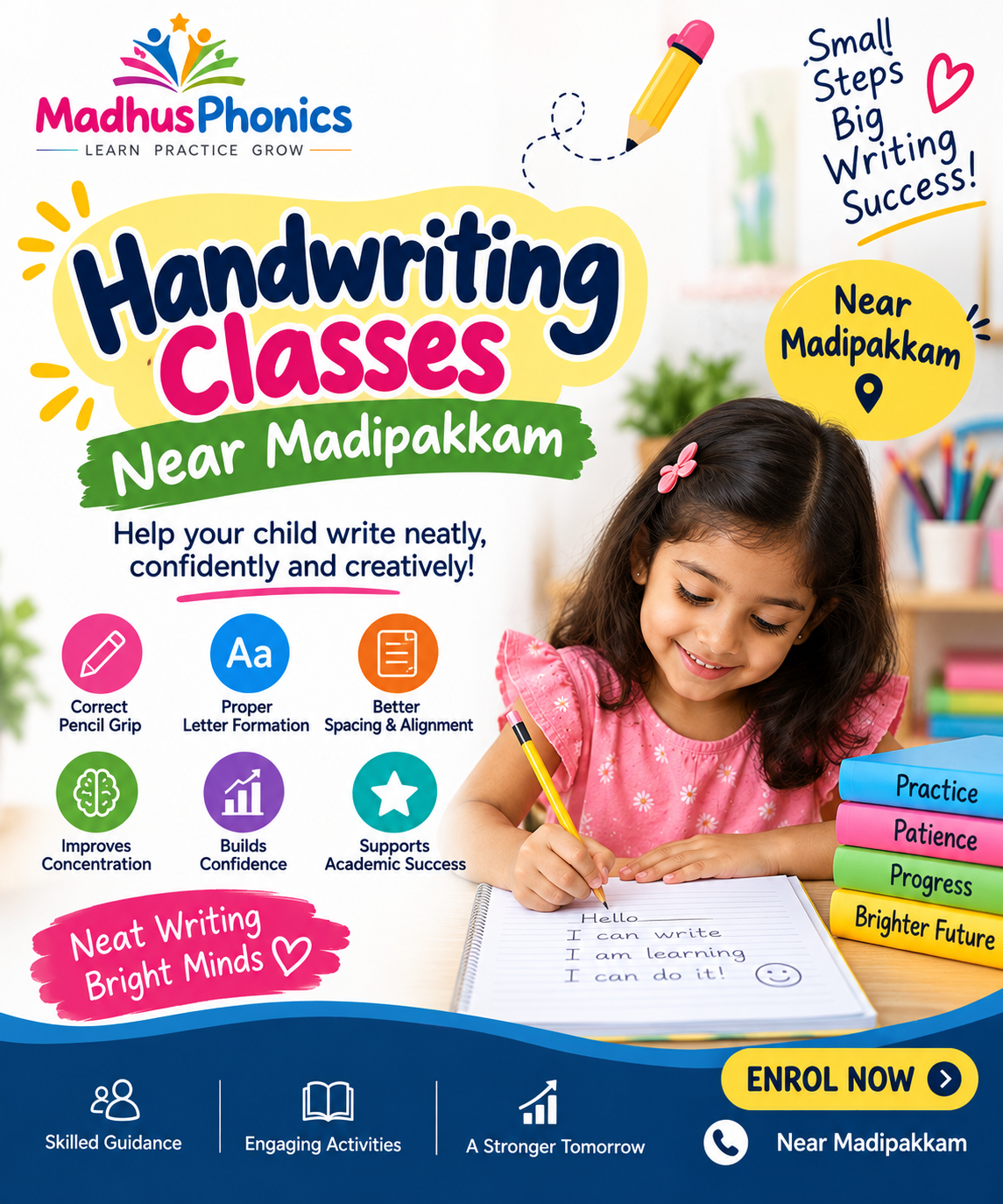
If you are searching for handwriting classes near Madipakkam, MadhusPhonics offers a supportive and engaging learning environment where children can practise and improve their handwriting skills step by step.
Good handwriting is not achieved simply by asking children to write the same letters repeatedly. Children need to understand correct letter formation, pencil control, spacing, alignment, size, and writing movement. With structured guidance and consistent practice, children can gradually develop handwriting that is neat, readable, and comfortable.
Why Is Handwriting Important for Children?
Handwriting is closely connected with a child’s everyday learning experience. Although children today are increasingly exposed to digital devices, handwriting continues to play an important role in school education.
Children write in notebooks, complete worksheets, take examinations, make notes, and submit assignments. When their handwriting is difficult to read or they struggle to write comfortably, it can sometimes affect their overall classroom experience.
Good handwriting can help children:
Write more clearly
Complete written activities comfortably
Develop better pencil control
Maintain appropriate spacing
Improve letter formation
Organise written work
Develop writing confidence
Improve concentration during writing activities
Present schoolwork neatly
Develop better writing habits
Handwriting classes provide children with an opportunity to focus specifically on these areas.
Handwriting Classes Near Madipakkam for Children
Parents in Madipakkam and nearby areas often look for educational classes that can complement their child’s regular school learning. Handwriting is one such skill that can benefit children throughout their academic years.
At MadhusPhonics, handwriting activities are designed to make learning simple and enjoyable. Children can be introduced to writing concepts according to their individual learning level.
A beginner may need more practice with basic strokes, curves, patterns, and alphabet formation. Another child may already know the alphabet but need support with spacing, alignment, consistency, or writing speed.
The focus should always be on gradual improvement rather than comparing one child’s handwriting with another.
What Do Children Learn in Handwriting Classes?
Handwriting involves several different skills. Developing each of these skills can help children become more comfortable and confident writers.
1. Proper Pencil Grip
Pencil grip is an important part of early handwriting development.
Children need sufficient control over the pencil to create smooth strokes without applying unnecessary pressure. A comfortable grip can help reduce hand fatigue during writing.
Handwriting activities can encourage children to develop better pencil control while practising different strokes and letter shapes.
2. Basic Writing Strokes
Before writing complete letters, children benefit from understanding basic strokes.
These can include:
Straight lines
Curved lines
Slanting lines
Loops
Circles
Waves
Zigzag patterns
Practising these movements can help children develop the coordination required for forming letters.
3. Correct Letter Formation
One of the key objectives of handwriting practice is helping children form letters correctly.
Children learn where to begin a letter, the direction of movement, and how the individual strokes come together.
Consistent letter formation can make handwriting more readable and help children develop a natural writing rhythm.
4. Letter Size
Children sometimes write letters in inconsistent sizes. One letter may be very large while another is extremely small.
Handwriting practice helps children understand appropriate letter proportions and maintain consistency while writing words and sentences.
5. Proper Spacing
Spacing is another important aspect of neat handwriting.
Children need to understand the difference between spacing within letters, between letters, and between words.
Appropriate spacing makes sentences easier to read and gives written work a more organised appearance.
6. Line Alignment
Writing along the correct line can make a significant difference to handwriting presentation.
Children learn how letters should sit on the writing line and how certain letters extend above or below it.
With regular practice, maintaining alignment can become more natural.
7. Writing Speed and Fluency
As children become comfortable with letter formation, they can gradually develop better writing fluency.
The objective is not to make children write as quickly as possible. Instead, they should learn to write at a comfortable speed while maintaining clarity and consistency.
How Handwriting Classes Can Build Confidence
Children can sometimes become discouraged when they feel their handwriting is not as neat as they would like.
They may hesitate to write on the board, complete assignments slowly, or avoid activities that involve a lot of writing.
Regular handwriting practice can help children see their own progress.
When a child notices that their letters are becoming clearer, their spacing is improving, or they can write a sentence more comfortably, it can create a sense of achievement.
This gradual improvement can contribute to greater confidence in school-related writing activities.
Handwriting and Fine Motor Development
Writing requires controlled movements of the fingers, hands, and wrist. Children need to coordinate these movements while simultaneously looking at the letters or words they are writing.
This is why handwriting practice can also support fine motor development.
Activities involving tracing, patterns, colouring, drawing, and writing can encourage children to develop greater control over small hand movements.
Better fine motor control can also be useful for activities such as:
Drawing
Colouring
Craft work
Cutting with scissors
Using classroom tools
Writing numbers
Completing worksheets
Other hands-on activities
Handwriting therefore contributes to more than simply producing neat letters.
Why Choose MadhusPhonics for Handwriting Classes Near Madipakkam?
When choosing handwriting classes, parents often look for a place where children can learn without feeling pressured.
MadhusPhonics focuses on creating a positive learning experience where children can practise, make mistakes, receive guidance, and improve gradually.
A structured handwriting programme can help identify the areas where a child requires more practice.
For some children, the focus may be pencil control. For others, it may be letter size, spacing, alignment, or writing consistency.
By working on these areas step by step, children can develop stronger handwriting habits.
Who Can Benefit from Handwriting Classes?
Handwriting classes can be useful for children at different stages of their education.
They may be suitable for:
Preschool children beginning pre-writing activities
Kindergarten children learning alphabets
Primary school children
Children with inconsistent handwriting
Children who need better pencil control
Children who struggle with letter formation
Children who write with irregular spacing
Children who want to improve neatness
Students who want better writing presentation
Children who need more confidence in writing
The learning approach can be adjusted according to the child’s current skill level.
Making Handwriting Practice Enjoyable
Children are more likely to practise when learning feels interesting.
Instead of making handwriting practice feel like a punishment or repetitive task, activities can be introduced in a more engaging way.
Children can practise through:
Tracing activities
Alphabet exercises
Pattern worksheets
Word writing
Sentence practice
Picture-based writing
Copywriting activities
Number writing
Short creative writing exercises
Guided handwriting worksheets
Different activities can keep children interested while giving them opportunities to repeat important writing movements.
How Parents Can Support Handwriting at Home
Handwriting classes can provide structured practice, but parents can reinforce these skills at home.
Parents can create a simple writing routine where children practise for a few minutes each day.
A comfortable study area with good lighting can make writing easier. Children should also have suitable notebooks and pencils.
Parents can encourage children by focusing on progress rather than perfection.
For example, instead of pointing out every mistake, parents can choose one area to improve at a time.
If spacing is the main problem, encourage the child to focus on spacing. Once that improves, attention can move to letter size or alignment.
Positive encouragement can make children more willing to practise.
Why Regular Practice Matters
Handwriting is a skill that develops over time. A child cannot usually transform their handwriting in a single class or a few days.
Regular practice gives children repeated opportunities to develop muscle memory and become comfortable with writing movements.
Short and consistent practice sessions can be more effective than forcing children to write for long periods.
Parents and teachers should also remember that every child develops at a different pace.
Patience and encouragement are important parts of the learning process.
Handwriting Classes for Children in and Around Madipakkam
Madipakkam and its surrounding neighbourhoods have many families looking for quality learning opportunities for children.
If you are searching online for handwriting classes near Madipakkam, choosing a programme that focuses on the child’s individual development can be a valuable step.
MadhusPhonics aims to support children as they develop their writing skills through guided practice and child-friendly learning activities.
Whether a child is just beginning to write or already has basic writing skills but needs improvement in neatness and consistency, structured handwriting practice can help them progress.
Give Your Child a Strong Foundation in Handwriting
Good handwriting starts with small habits.
Holding the pencil comfortably, forming letters correctly, maintaining consistent size, leaving appropriate spaces, and following the writing line may seem like simple skills, but together they form the foundation of effective handwriting.
With regular guidance, children can become more comfortable with writing and gradually develop greater confidence.
Parents looking for handwriting classes near Madipakkam can consider MadhusPhonics as an option for helping their children strengthen their handwriting skills in a supportive learning environment.
Frequently Asked Questions
What age is suitable for handwriting classes?
Children can begin handwriting-related activities when they are developmentally ready for pencil and pre-writing activities. The activities can be adjusted according to the child’s age and existing skills.
Can handwriting classes help improve messy handwriting?
Yes. Structured practice can focus on areas such as letter formation, spacing, alignment, pencil control, and consistency, which can help children work toward neater handwriting.
How long does it take to improve handwriting?
Every child is different. Improvement depends on factors such as age, existing writing habits, practice frequency, and individual learning needs. Consistent practice can support gradual improvement.
Should children practise handwriting every day?
Regular practice can be helpful. Short, focused practice sessions can help children develop consistency without making writing feel tiring or stressful.
Can handwriting classes help school students?
Yes. School students regularly use handwriting for classwork, homework, examinations, projects, and written assignments. Improving handwriting can make these activities more comfortable and organised.
Are handwriting classes useful for beginners?
Absolutely. Beginners can work on basic strokes, pencil control, alphabet formation, and other foundational skills before progressing to words and sentences.
Conclusion
Handwriting remains an important skill in a child’s educational journey. Developing good handwriting requires more than simply copying letters. Children need opportunities to practise pencil control, letter formation, spacing, alignment, size, and writing fluency.
For parents searching for handwriting classes near Madipakkam, MadhusPhonics provides a child-friendly learning environment where children can work on their handwriting skills through structured and engaging activities.
With patience, regular practice, and the right guidance, children can gradually develop handwriting that is neat, clear, comfortable, and confident.
MadhusPhonics – Learn, Practise and Grow
Give your child the opportunity to build stronger handwriting habits from an early age.
Looking for handwriting classes near Madipakkam? Choose MadhusPhonics and help your child take the next step toward better writing and greater confidence.