
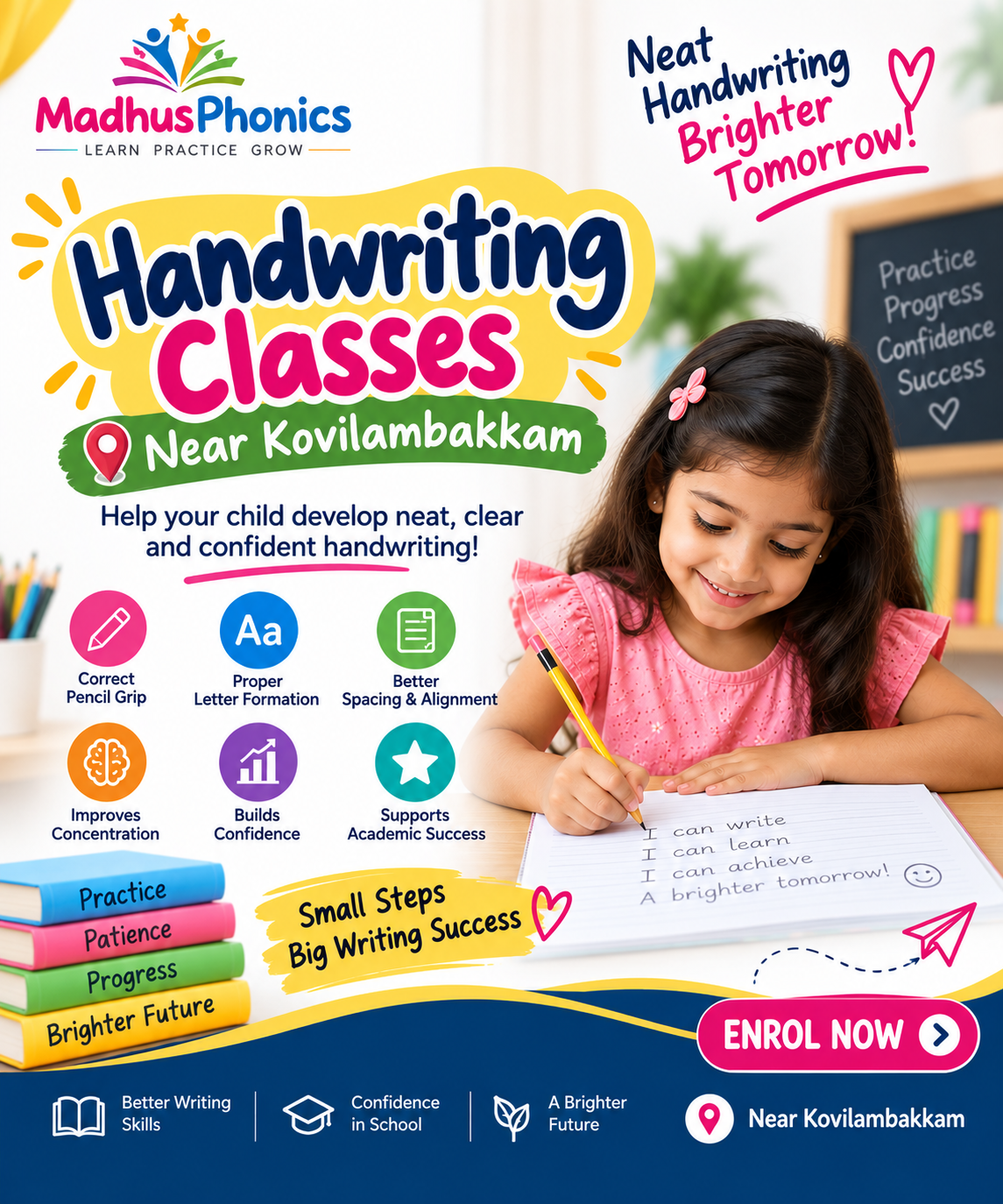
Handwriting Classes Near Kovilambakkam
Handwriting is one of the most important foundational skills children develop during their early years of education. Before children begin writing paragraphs, completing examinations, or preparing school projects, they first need to learn how to hold a pencil, create basic strokes, form letters, maintain spacing, and write comfortably.
For parents searching for handwriting classes near Kovilambakkam, finding the right learning environment can make a meaningful difference in a child’s writing journey. With structured guidance, regular practice, and encouragement, children can gradually develop handwriting that is neat, readable, consistent, and comfortable.
MadhusPhonics provides child-friendly learning experiences designed to help children strengthen essential writing skills while making practice enjoyable and engaging.
Why Is Handwriting Important for Children?
Even with the growing use of computers, tablets, and smartphones, handwriting continues to be an essential part of school education. Children write every day as part of their classwork, homework, examinations, worksheets, assignments, and creative activities.
When children have good handwriting habits, they may find written tasks easier to manage. Clear handwriting also allows their ideas and answers to be presented in an organised manner.
Developing handwriting skills can help children work on:
Pencil control
Letter formation
Letter size and consistency
Word spacing
Line alignment
Writing fluency
Hand-eye coordination
Concentration
Writing confidence
Presentation of schoolwork
These skills are developed gradually through appropriate instruction and consistent practice.
Handwriting Classes Near Kovilambakkam for Children
Kovilambakkam and its surrounding areas are home to many families who are interested in additional learning activities for their children. Parents often look for classes that can support their child’s regular school education.
Handwriting classes can be a useful option because handwriting is not a skill children use only once a week. It is something they practise throughout their academic life.
At MadhusPhonics, children can be introduced to handwriting concepts according to their learning level. A beginner may need to work on basic strokes and pencil control, while an older child may need help with spacing, alignment, neatness, or writing speed.
This step-by-step approach allows children to build their skills progressively.
What Happens in Handwriting Classes?
Handwriting involves several different abilities that work together. A good handwriting programme can address each area individually.
1. Learning the Correct Pencil Grip
A comfortable pencil grip gives children better control over their writing movements.
Young children sometimes hold their pencils too tightly or use an awkward grip. This may make writing uncomfortable and can affect the smoothness of their strokes.
Guided practice can help children become more aware of how they hold and move their pencils.
2. Developing Basic Strokes
Before children can confidently write letters, they need to become familiar with basic writing movements.
These may include:
Vertical lines
Horizontal lines
Slanting lines
Curves
Circles
Loops
Waves
Zigzag patterns
Practising these movements can help children develop the coordination needed for alphabet formation.
3. Correct Letter Formation
Letter formation is one of the foundations of good handwriting.
Children learn that each letter has a particular structure and movement pattern. Learning how to start and complete letters correctly can help prevent inconsistent or reversed letter shapes.
Regular practice can help these movements become more natural over time.
4. Consistent Letter Size
A common handwriting difficulty among young learners is inconsistent letter size.
Some letters may be large while others are much smaller. This can make words look uneven.
Handwriting activities can help children understand proportions and maintain a more consistent size across letters and words.
5. Better Spacing Between Words
Proper spacing is essential for readable handwriting.
When children write words too close together, sentences can become difficult to understand. On the other hand, excessive spacing can make writing look disconnected.
Children can practise maintaining appropriate spaces between words to create cleaner and more organised sentences.
6. Alignment and Writing on the Line
Writing on the line is another important handwriting habit.
Children need to understand where letters should sit and which letters extend above or below the writing line.
With repeated practice, children can become more comfortable maintaining consistent alignment.
7. Developing Writing Fluency
Once children become comfortable with letter formation and spacing, they can gradually work on writing fluency.
Fluent writing means being able to write comfortably without having to think about every individual stroke.
The objective is not simply to make children write faster. Good writing should balance speed, comfort, neatness, and readability.
Benefits of Handwriting Classes for Children
Structured handwriting practice can offer several benefits to young learners.
Improved Writing Neatness
Children can learn how to maintain consistent letter shapes, sizes, spacing, and alignment.
Better Pencil Control
Regular writing activities can help children become more comfortable controlling their pencils.
Improved Concentration
Handwriting requires children to pay attention to details such as letter shape, spacing, and position.
Greater Confidence
When children notice that their handwriting is improving, they may become more confident about completing written activities.
Better Presentation
Neat handwriting can make notebooks, assignments, worksheets, and other written work easier to read and visually organised.
Better Writing Habits
Early guidance can help children establish good handwriting habits before inefficient writing patterns become difficult to change.
Handwriting and Fine Motor Skills
Handwriting requires controlled movements of the fingers, hands, and wrist. Children must coordinate these movements while visually following letters and words.
This makes handwriting practice closely connected with fine motor development.
Fine motor activities can support children’s ability to perform other tasks that require precision, including:
Drawing
Colouring
Cutting
Craft activities
Using classroom tools
Writing numbers
Completing worksheets
Manipulating small objects
By giving children regular opportunities to practise controlled movements, handwriting activities can become part of broader skill development.
Why Choose MadhusPhonics?
Parents searching for handwriting classes near Kovilambakkam often want more than worksheets. They want a learning environment where their children can develop skills without feeling pressured.
MadhusPhonics focuses on creating an engaging and supportive experience for children.
Every child may have different handwriting challenges. One child may struggle with pencil grip, while another may have difficulty with spacing or letter size.
Instead of expecting every child to progress in exactly the same way, handwriting practice can focus on the skills each learner needs to strengthen.
The goal is steady improvement and positive learning habits.
Who Can Join Handwriting Classes?
Handwriting classes can be useful for children at different learning stages.
They may be suitable for:
Preschool children beginning pre-writing activities
Kindergarten students
Early primary school children
Children learning alphabet formation
Children with inconsistent handwriting
Children who struggle with spacing
Children who need better pencil control
Children who write too slowly
Children who want to improve handwriting presentation
Students preparing for more demanding written schoolwork
The type of practice can be adjusted according to the child’s age and current writing ability.
Making Handwriting Practice Interesting
Children learn better when activities are enjoyable.
Handwriting practice does not have to involve copying the same sentence repeatedly. A variety of activities can make learning more engaging.
Children can practise through:
Tracing exercises
Alphabet activities
Pattern writing
Word formation
Picture-based writing
Sentence practice
Guided copying
Number writing
Creative writing exercises
Handwriting worksheets
These activities can give children repeated practice without making the experience monotonous.
How Parents Can Support Handwriting at Home
Parents play an important role in reinforcing handwriting skills.
A few minutes of regular practice at home can help children maintain consistency.
Parents can provide:
A comfortable study table
Good lighting
Appropriate writing materials
Ruled notebooks
Short and regular practice sessions
Encouragement and positive feedback
It is also important not to criticise children excessively for messy handwriting.
Instead, parents can focus on one improvement at a time.
For example, if a child struggles with spacing, encourage them to focus on leaving appropriate spaces between words. Once this becomes more consistent, attention can move toward letter size or alignment.
Regular Practice Makes a Difference
Handwriting improvement takes time.
Children develop handwriting through repeated movements and practice. Consistency allows them to become more familiar with letter shapes and writing patterns.
Short practice sessions performed regularly can be more effective than making children write for a long time occasionally.
Parents should also understand that children develop at different speeds. Comparing one child’s handwriting with another can create unnecessary pressure.
Encouragement and patience can make the learning journey more positive.
Handwriting Classes for Children Around Kovilambakkam
For families living in Kovilambakkam and nearby neighbourhoods, finding a convenient and child-focused handwriting programme can be a useful step toward supporting a child’s writing development.
If you are searching online for handwriting classes near Kovilambakkam, MadhusPhonics can be considered for structured handwriting learning.
The focus is on developing the fundamentals of handwriting while helping children become more comfortable and confident with writing.
Whether your child is just beginning to learn letters or already writes but needs improvement in neatness and consistency, guided handwriting practice can provide valuable support.
Helping Your Child Develop Better Writing Habits
Good handwriting starts with simple habits.
A comfortable pencil grip, correct letter formation, suitable spacing, consistent letter size, and proper alignment all contribute to readable handwriting.
When these skills are practised regularly, children can gradually develop a natural writing rhythm.
The objective should not be perfection from the first day. Instead, children should be encouraged to recognise their progress and continue practising.
Each correctly formed letter, properly spaced word, and neatly completed sentence is a small step forward.
Frequently Asked Questions
1. What age can children start handwriting classes?
Children can begin handwriting-related learning when they are ready for basic pencil and pre-writing activities. The exercises can be adapted to suit their age and skill level.
2. Can handwriting classes help children with messy handwriting?
Yes. Children can work on specific areas such as pencil control, letter formation, spacing, alignment, and consistency through structured practice.
3. How often should children practise handwriting?
Regular practice is generally helpful. Short and focused sessions can help children build consistency without making them feel tired or overwhelmed.
4. Can handwriting classes improve writing speed?
As children become more comfortable with letter formation and pencil movement, they can gradually develop better writing fluency and speed while maintaining readability.
5. Are handwriting classes useful for school students?
Yes. School students regularly need handwriting for classwork, homework, tests, examinations, projects, and assignments. Better handwriting can make written activities more comfortable and organised.
6. Can beginners join handwriting classes?
Yes. Beginners can start with basic strokes, pencil control, and letter formation before progressing to words and sentences.
7. Where can I find handwriting classes near Kovilambakkam?
Parents looking for handwriting classes near Kovilambakkam can explore MadhusPhonics for child-friendly handwriting learning and guided practice.
Conclusion
Handwriting is a valuable skill that supports children throughout their educational journey. Learning to write neatly involves much more than copying letters. Children need to develop pencil control, correct letter formation, appropriate spacing, consistent sizing, alignment, and writing fluency.
For parents searching for handwriting classes near Kovilambakkam, MadhusPhonics offers a supportive environment where children can practise these essential skills through structured and engaging activities.
With regular practice, patient guidance, and positive encouragement, children can gradually develop handwriting that is clear, neat, comfortable, and confident.
MadhusPhonics – Learn, Practise, Grow
Give your child a strong foundation for better handwriting and confident learning.
Looking for handwriting classes near Kovilambakkam? Choose MadhusPhonics and help your child take the next step toward better writing skills.