
Grammar Classes in Kovilambakkam English grammar plays an important role in helping children communicate clearly, write confidently, and understand the English language better. A child may know many English words, but without a proper understanding of grammar, it can be difficult to form meaningful sentences or express ideas correctly. This is why choosing the right grammar classes in Kovilambakkam can make a significant difference in a child’s language development. At Madhu’s Phonics & Handwriting, we focus on making English grammar simple, practical, and enjoyable for children. Our learning approach is designed to help students understand grammar concepts rather than simply memorize rules. Through structured lessons, activities, examples, and regular practice, children can gradually develop stronger grammar skills and greater confidence in using English. Why Are English Grammar Skills Important for Children? Grammar is the foundation of effective communication. It helps children understand how words work together to create meaningful sentences. Strong grammar skills can support children in their schoolwork, reading, writing, speaking, and everyday communication. When children learn grammar from an early stage, they can develop better sentence-building abilities. They become more comfortable identifying nouns, verbs, adjectives, pronouns, tenses, prepositions, conjunctions, and other important parts of English. Grammar also supports academic performance. Children regularly use English while answering questions, writing paragraphs, completing assignments, preparing projects, and participating in classroom activities. A strong foundation in grammar can help them communicate their answers more accurately. Grammar Classes in Kovilambakkam for Better Language Development Parents looking for grammar classes in Kovilambakkam often want more than traditional textbook-based teaching. Children learn differently, and grammar lessons need to be presented in a way that keeps them interested. At Madhu’s Phonics & Handwriting, grammar learning can be introduced through age-appropriate explanations and practical examples. Instead of overwhelming children with complicated terminology, concepts can be broken down into smaller and easier steps. For example, rather than simply asking a child to memorize the definition of a noun, we can introduce nouns through familiar objects, people, animals, and places. Similarly, verbs can be taught using actions and everyday situations. This practical approach helps children connect grammar rules with real-life English usage. What Can Children Learn in Grammar Classes? A well-structured grammar program can cover a wide range of essential English concepts. Depending on the child’s age and learning level, lessons may include: Nouns Children learn how to identify naming words such as people, places, animals, objects, and things. They can gradually understand different types of nouns and how nouns are used in sentences. Pronouns Pronouns help children avoid unnecessary repetition while speaking and writing. Students can learn words such as he, she, it, they, we, you, and other commonly used pronouns. Verbs Verbs describe actions or states. Children can learn to identify verbs and use them correctly while creating sentences. Adjectives Adjectives make communication more descriptive. Children can learn how words such as beautiful, tall, small, bright, happy, and interesting add information to sentences. Adverbs Students can understand how adverbs provide additional information about actions, such as how, when, or where something happens. Articles The use of a, an, and the can sometimes be confusing for young learners. Regular practice can help children understand when and how these articles are used. Prepositions Words such as in, on, under, beside, between, behind, and near are important for describing relationships between words. Children can learn these concepts through practical examples. Tenses Understanding past, present, and future forms is an important part of English grammar. Children can learn how verbs change according to the time of an action. Conjunctions Words such as and, but, because, or, and so help children connect ideas and create better sentences. Sentence Formation Children can learn how to arrange words in the correct order to form meaningful sentences. Sentence-building activities can also improve their writing skills. Punctuation Correct punctuation makes written communication easier to understand. Students can learn about full stops, commas, question marks, exclamation marks, quotation marks, and other commonly used punctuation. Learning Grammar Through Activities Children often learn more effectively when lessons involve participation rather than only listening to explanations. Grammar activities can make classes more engaging and help students remember concepts. At Madhu’s Phonics & Handwriting, grammar learning can incorporate activities such as sentence-building exercises, word games, fill-in-the-blanks, vocabulary activities, picture-based sentences, correction exercises, reading activities, and creative writing. For example, a teacher may provide a picture and ask children to describe what they see. Students can then identify nouns, verbs, and adjectives in their sentences. This allows multiple grammar concepts to be practiced together. Such activities can make grammar feel less like a difficult subject and more like an enjoyable language-learning experience. Grammar and Writing Skills Go Together Grammar is closely connected to writing. Children who understand sentence structure can gradually develop better written communication skills. When students write stories, descriptions, letters, paragraphs, or answers to school questions, grammar helps them organize their thoughts. A child who understands how to use verbs, adjectives, conjunctions, punctuation, and sentence structures can express ideas more clearly. This is particularly useful for students who know what they want to say but struggle to put their thoughts into correct English sentences. Grammar Classes Can Improve Speaking Confidence Grammar is not only about writing. It also plays a role in spoken English. Children may sometimes hesitate to speak because they are worried about making mistakes. A supportive learning environment can encourage them to practice speaking without fear. Simple grammar-based speaking activities can include introducing themselves, describing objects, talking about their daily routine, answering questions, describing pictures, and creating short conversations. With consistent practice, children can become more comfortable forming sentences and expressing themselves in English. Why Choose Madhu’s Phonics & Handwriting? Choosing the right learning environment is important when parents search for grammar classes in Kovilambakkam. Madhu’s Phonics & Handwriting focuses on building strong foundational language skills in children. Grammar can be taught alongside phonics, reading, vocabulary, handwriting, and writing practice to create a more complete English learning experience. Our goal is to help children understand concepts

Grammar class in chennai
Grammar Classes in Chennai In today’s competitive world, strong English communication skills can make a meaningful difference in a student’s academic, professional, and personal life. Grammar is one of the most important foundations of effective English. Whether a child is learning basic sentence formation, a school student is preparing for examinations, or an adult wants to communicate more confidently, proper grammar helps make spoken and written English clearer and more accurate. Finding the right Grammar class in Chennai can provide learners with structured guidance, regular practice, and an environment where they can improve their language skills step by step. A good grammar program does not simply teach rules from a textbook. It helps students understand how grammar works in real conversations, writing, reading, and everyday communication. Why Grammar Is Important for English Learning Grammar provides the structure needed to communicate ideas correctly. Words alone are not enough to form meaningful communication. The way words are arranged and connected determines the meaning of a sentence. For example: “She is reading a book.” “She was reading a book.” “She will read a book.” The basic idea is similar, but the tense changes the time of the action. Understanding such differences allows students to communicate accurately. Grammar also helps learners avoid common mistakes in speaking and writing. When children develop a strong grammatical foundation at an early age, they often find it easier to improve vocabulary, reading comprehension, creative writing, and overall communication. Grammar Classes in Chennai for Different Age Groups Chennai has learners with different educational backgrounds and language requirements. Therefore, grammar training should not follow a single approach for everyone. A well-designed Grammar class in Chennai can be adapted according to the learner’s age, current skill level, and learning goals. Grammar Classes for Kids Children can start learning basic grammar through simple and enjoyable activities. Instead of memorizing complicated definitions, young learners can understand grammar through stories, pictures, conversations, games, and practical exercises. Important areas may include: Alphabet and word recognition Naming words Action words Describing words Pronouns Singular and plural Articles Basic sentence formation Simple tenses Prepositions Question formation Everyday vocabulary Interactive learning can make grammar less intimidating for young children. When lessons are connected with familiar situations, children can understand and remember concepts more effectively. Grammar Classes for School Students School students need grammar for both academic performance and everyday communication. English grammar is commonly included in school examinations, assignments, comprehension exercises, and writing activities. A structured grammar course can help students improve areas such as: Parts of speech Nouns and pronouns Verbs and helping verbs Adjectives and adverbs Prepositions Conjunctions Articles Tenses Subject-verb agreement Active and passive voice Direct and indirect speech Sentence transformation Question tags Punctuation Vocabulary usage Regular practice is particularly important because students may understand a grammar rule but still make mistakes when using it independently. Learning Grammar Through Practical Examples One of the best ways to learn grammar is through practical application. Instead of only learning the definition of a verb, students can identify verbs in sentences and use them in their own examples. For instance: Basic sentence:“Ravi plays cricket.” Students can then modify it: Past tense:“Ravi played cricket.” Future tense:“Ravi will play cricket.” Present continuous:“Ravi is playing cricket.” This type of activity helps learners understand how grammar changes depending on the context. Understanding Tenses Tenses are an essential part of English grammar. Many learners find them confusing because English uses different structures to describe actions occurring at different times. A good grammar program can introduce tenses gradually. Present Tense “I go to school every day.” Past Tense “I went to school yesterday.” Future Tense “I will go to school tomorrow.” Once students understand the basic concept, they can gradually learn continuous, perfect, and perfect continuous forms. Practicing tenses through everyday situations can make the learning process easier. Improving Sentence Formation Sentence formation is another major component of grammar learning. Some students know many English words but struggle to arrange them correctly. For example, learners may know the words: “school,” “go,” “I,” “every day.” A grammar exercise helps them form: “I go to school every day.” With regular practice, students become more comfortable creating sentences independently. Grammar and Spoken English Grammar and spoken English are closely connected. While communication does not require every sentence to be perfect, basic grammatical accuracy helps speakers express their thoughts clearly. Grammar classes can incorporate speaking activities such as: Self-introduction Picture description Storytelling Question-and-answer sessions Role play Group conversations Daily-life dialogues Vocabulary games Short presentations These activities allow students to apply grammar while speaking rather than learning it only as theory. Grammar for Better Writing Skills Strong grammar is particularly useful for writing. Students who understand sentence structure can write paragraphs, essays, letters, stories, and answers more effectively. Grammar training can help learners understand: How to begin a sentence How to connect ideas Where to use punctuation How to maintain correct tense How to avoid repetition How to create meaningful paragraphs How to identify and correct grammatical errors Better grammar can make writing easier to understand and more professional. Common Grammar Mistakes Students Make Students learning English often make mistakes because their first language may have a different sentence structure. Some common examples include: Incorrect: He go to school every day.Correct: He goes to school every day. Incorrect: She have a book.Correct: She has a book. Incorrect: I am knowing the answer.Correct: I know the answer. Incorrect: They was playing.Correct: They were playing. Identifying such mistakes and practicing the correct forms repeatedly can gradually improve accuracy. Why Regular Practice Matters Grammar cannot usually be mastered by attending a few classes and memorizing rules. Consistent practice is important. A learner can spend a short amount of time each day: Reading a paragraph. Identifying different parts of speech. Writing five sentences. Practicing one tense. Speaking about a daily topic. Correcting common grammar mistakes. Small, regular activities can help reinforce concepts over time. Choosing the Right Grammar Class in Chennai Parents and learners may find several English learning options in Chennai.
handwriting classes near Nanmangalam
Handwriting Classes Near Nanmangalam Handwriting is one of the most important foundational skills children develop during their early school years. Although children today are surrounded by digital devices, writing by hand continues to play an essential role in education. From completing homework and classwork to writing examinations and assignments, children need handwriting that is clear, comfortable, and easy to read. For parents searching for handwriting classes near Nanmangalam, choosing the right training program can help children develop stronger writing habits from an early age. Madhu’s Phonics offers structured and child-friendly handwriting training designed to help children improve letter formation, pencil control, spacing, alignment, neatness, and writing confidence. Why Is Good Handwriting Important for Children? Handwriting is not simply about making letters look attractive. It involves several skills working together, including fine motor coordination, concentration, visual perception, pencil control, and memory. When children develop good handwriting habits, they can complete written activities more comfortably. Clear handwriting also makes it easier for teachers to read their work and for children to review their own notes. Good handwriting can help children with: Better letter formation Improved pencil control Consistent letter size Proper spacing between words Better alignment Improved writing speed Neater schoolwork Greater writing confidence Better presentation of answers More comfortable writing habits This is why many parents consider professional handwriting classes near Nanmangalam as an important part of their child’s overall learning development. Handwriting Classes Near Nanmangalam for Children Every child learns differently. Some children naturally develop neat handwriting, while others may need additional guidance and practice. Children may also develop incorrect writing habits when they are first learning to write. For example, a child may hold the pencil incorrectly, make letters too large or too small, leave uneven spaces between words, or struggle to write on the ruled line. These habits can become difficult to change if they continue for a long period. A structured handwriting program gives children an opportunity to practise these skills under proper guidance. At Madhu’s Phonics, handwriting development focuses on helping children improve gradually. Instead of expecting immediate perfection, children are encouraged to practise the fundamentals and build confidence step by step. What Do Children Learn in Handwriting Classes? A comprehensive handwriting program should cover more than just copying letters and words. Children need to understand how letters are formed and how they can maintain consistency while writing sentences and paragraphs. 1. Correct Letter Formation Correct letter formation is one of the first steps toward developing neat handwriting. Children learn the appropriate strokes and patterns used to form letters. Developing these movements correctly can help children write letters more consistently. Early practice is especially useful because children are still developing their writing habits. 2. Pencil Grip and Control Pencil grip plays an important role in handwriting. An uncomfortable or incorrect grip can make writing difficult and may cause children to become tired during longer writing activities. Handwriting exercises can help children develop better control of the pencil and make their writing movements smoother. 3. Letter Size and Consistency Children sometimes write the same letter in different sizes. Inconsistent letter sizes can make words appear untidy. Through regular practice, children can learn to maintain more consistent letter height and proportions. This contributes to cleaner and more readable handwriting. 4. Spacing Between Letters and Words Proper spacing is an important part of handwriting. If letters or words are placed too close together, sentences can become difficult to read. Excessive spacing can also make writing appear disconnected. Children can practise maintaining appropriate spacing so that their writing becomes easier to understand. 5. Line Alignment Writing on the line can be challenging for young learners. Some children may write above the line, while others may allow letters to move below it unnecessarily. Guided handwriting exercises help children understand how letters should sit on ruled lines and how different letter shapes relate to the writing line. 6. Writing Speed As children progress through school, they need to write longer answers within limited periods. Neat handwriting should therefore be combined with comfortable writing speed. Regular practice can help children become more fluent while maintaining readable handwriting. Benefits of Joining Handwriting Classes Parents searching for handwriting classes near Nanmangalam may wonder whether additional handwriting training is really necessary. While regular school practice is important, specialized handwriting classes can provide focused attention to specific writing difficulties. Improved Neatness Consistent practice can help children produce cleaner and more organized handwriting. Better Confidence Children who are unhappy with their handwriting may become hesitant about writing activities. Improvement can give them greater confidence. Improved Pencil Control Handwriting exercises provide opportunities for children to strengthen their control over writing movements. Better Writing Habits Children can learn appropriate habits relating to posture, pencil grip, letter formation, spacing, and alignment. More Comfortable Writing When children develop better writing movements, they may find longer writing activities easier and more comfortable. How Madhu’s Phonics Supports Handwriting Development Madhu’s Phonics provides a supportive environment where children can practise their handwriting skills in a structured manner. The focus is on gradual improvement rather than simply asking children to repeatedly copy pages of text. Children can receive guidance in areas such as: Basic strokes Uppercase letters Lowercase letters Letter formation Word formation Sentence writing Spacing Alignment Writing consistency Neatness Writing speed Activities can be adjusted according to the child’s learning stage and existing handwriting ability. Handwriting Classes for Different Age Groups Children at different educational stages have different handwriting needs. Preschool Children Preschool children are still developing their fine motor skills. Early handwriting activities can focus on basic strokes, patterns, shapes, pencil control, and introductory letter formation. Primary School Students Primary school children can work on improving letter formation, word spacing, alignment, size, and overall neatness. Middle School Students Older students often need to balance handwriting quality with writing speed. Training can help them develop more consistent handwriting while completing longer written tasks. Children Who Need Extra Practice Some children may struggle with handwriting despite regular school practice. Additional structured training can provide the
handwriting classes Near S. Kolathur
Handwriting Classes Near S. Kolathur Good handwriting is an important skill that supports a child’s academic development, confidence, and communication. In today’s digital world, children spend increasing amounts of time using smartphones, tablets, and computers, but handwriting remains an essential part of school education. From writing class notes and completing homework to answering examinations, children need to write clearly, comfortably, and confidently. For parents searching for handwriting classes near S. Kolathur, finding the right learning environment can make a significant difference in a child’s writing ability. Madhu’s Phonics offers structured and child-friendly handwriting training designed to help children develop better letter formation, spacing, alignment, writing speed, and overall presentation. Why Handwriting Is Important for Children Handwriting is more than simply putting letters on paper. It involves coordination between the eyes, hands, and brain. When children learn to write correctly, they develop several skills that can benefit them in their academic journey. Clear handwriting helps teachers understand a child’s answers easily. It also makes schoolwork, assignments, projects, and examination papers look more organized. Children who struggle with handwriting may take longer to complete written tasks and can sometimes lose confidence in their abilities. Regular handwriting practice can help children improve: Letter formation Pencil control Hand and finger coordination Writing speed Letter size and consistency Word spacing Line alignment Writing neatness Overall presentation Writing confidence This is why choosing professional handwriting classes near S. Kolathur can be a valuable investment in your child’s learning development. Handwriting Classes Near S. Kolathur for Young Learners Children develop writing skills at different speeds. Some children may naturally develop neat handwriting, while others need additional guidance and regular practice. A structured handwriting program can help children understand the correct way to form letters and gradually develop their own comfortable writing style. At Madhu’s Phonics, handwriting activities are designed to be engaging and age-appropriate. Instead of making handwriting practice feel like a repetitive task, children are encouraged to learn through guided exercises and consistent practice. The objective is not simply to make handwriting look beautiful. The focus is on developing legible, consistent, confident, and comfortable handwriting. What Children Can Learn in Handwriting Classes A good handwriting program should cover the fundamental aspects of writing rather than focusing only on appearance. At Madhu’s Phonics, children can work on different areas of handwriting development according to their learning stage. 1. Correct Letter Formation Correct letter formation is one of the foundations of good handwriting. Children learn how individual letters should be written, including the direction and sequence of strokes. Learning these patterns early can help children avoid common writing habits that may become difficult to correct later. 2. Pencil Grip and Control Holding a pencil correctly can influence writing comfort and control. Children who grip pencils too tightly or incorrectly may experience discomfort or fatigue while writing. Handwriting activities can help children develop better pencil control and improve their ability to create smooth and controlled strokes. 3. Letter Size and Proportion Children sometimes write letters in inconsistent sizes. One letter may be very large while another may be extremely small. Through guided practice, children can learn to maintain more consistent letter sizes and proportions. This makes words and sentences easier to read. 4. Spacing Between Words Proper spacing is another important part of readable handwriting. When words are written too close together, sentences can become difficult to understand. Children can learn how to maintain suitable spacing between letters and words, creating a cleaner and more organized appearance. 5. Writing on the Line Line alignment is especially important for young learners. Children need to understand how letters sit on ruled lines and how different letter shapes extend above or below the writing line. Regular practice can help children develop better alignment and consistency. 6. Writing Speed As children move into higher classes, they are expected to write more information in a limited amount of time. Neat handwriting should therefore be combined with comfortable writing speed. A structured handwriting program can help children gradually increase their writing speed without sacrificing readability. How Handwriting Classes Can Improve Academic Performance Handwriting and academics are closely connected, especially during the school years. Children regularly need to write answers, solve mathematics problems, complete worksheets, take notes, and prepare assignments. When handwriting is difficult or uncomfortable, children may spend more mental effort concentrating on the physical act of writing. With improved writing fluency, they can focus more comfortably on the content they are trying to communicate. Better handwriting can contribute to: Cleaner examination papers More organized school notes Easier homework completion Better written presentation Greater confidence during written activities Improved classroom participation While handwriting training alone cannot guarantee academic improvement, developing comfortable and readable handwriting can make everyday schoolwork easier for children. Why Choose Madhu’s Phonics? Parents looking for handwriting classes near S. Kolathur often want more than simple handwriting worksheets. They want a learning environment where their child receives appropriate guidance and encouragement. Madhu’s Phonics focuses on creating a supportive learning experience for children. Lessons can be structured according to the child’s age, existing handwriting ability, and learning requirements. The approach emphasizes practice, correction, repetition, and gradual improvement. Child-Friendly Learning Children learn more effectively when activities are interesting and encouraging. A positive learning atmosphere can help children participate actively instead of feeling pressured about their handwriting. Focus on Fundamentals Good handwriting starts with basic skills. Children can work on strokes, letter formation, spacing, alignment, and consistency before progressing toward more advanced writing practice. Regular Practice Handwriting improves through consistent practice. Children are encouraged to repeat writing patterns so that correct movements become more natural over time. Individual Attention Children may have different handwriting challenges. Some may struggle with letter formation, while others may have problems with spacing, size, or speed. Personalized guidance can help address these specific areas. Who Can Join Handwriting Classes? Handwriting classes can benefit children at different stages of their education. Preschool Children Young children can begin developing basic pencil control, strokes, shapes, and early writing habits. Primary School Children Primary
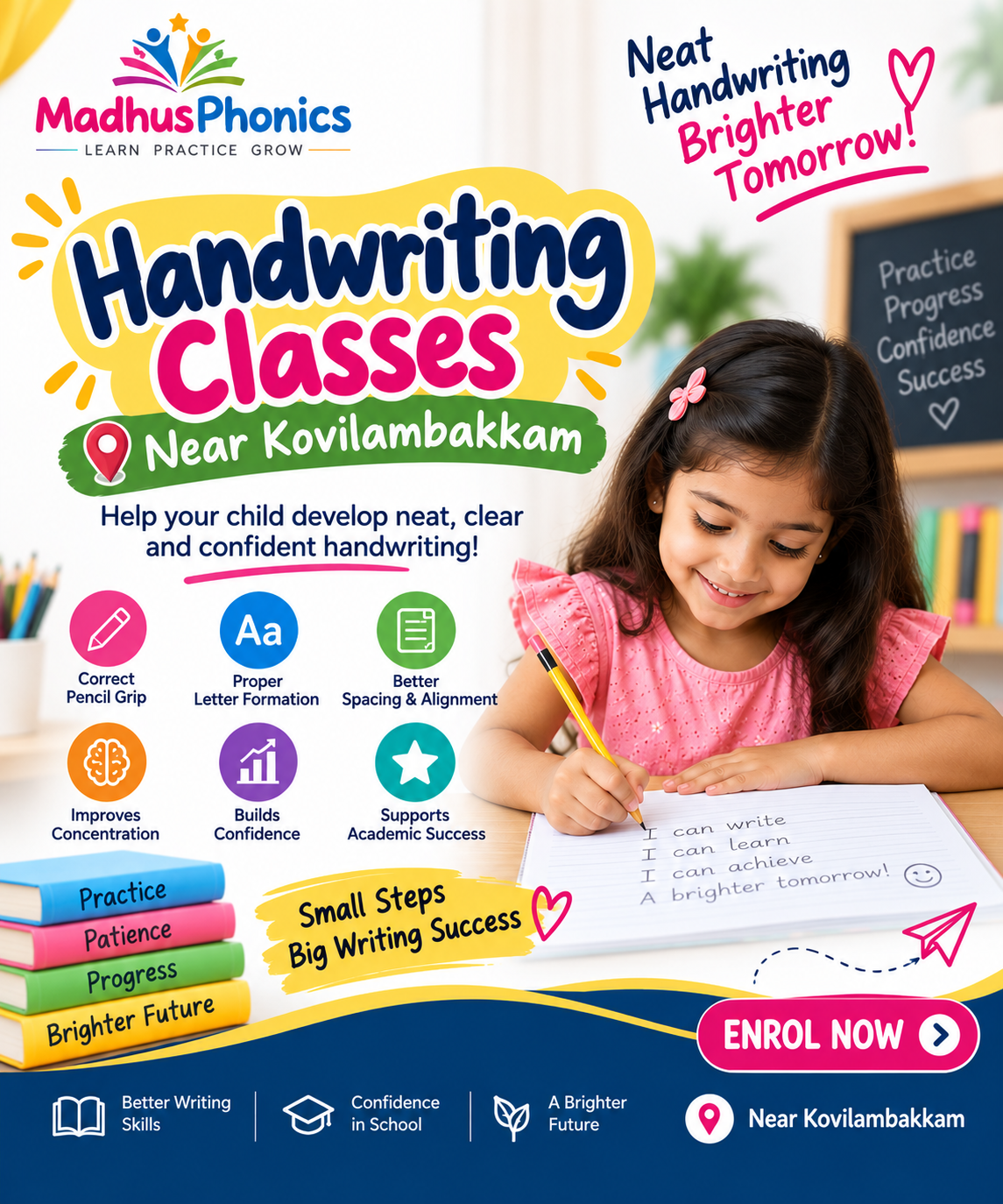
handwriting classes near Kovilambakkam
Handwriting Classes Near Kovilambakkam Handwriting is one of the most important foundational skills children develop during their early years of education. Before children begin writing paragraphs, completing examinations, or preparing school projects, they first need to learn how to hold a pencil, create basic strokes, form letters, maintain spacing, and write comfortably. For parents searching for handwriting classes near Kovilambakkam, finding the right learning environment can make a meaningful difference in a child’s writing journey. With structured guidance, regular practice, and encouragement, children can gradually develop handwriting that is neat, readable, consistent, and comfortable. MadhusPhonics provides child-friendly learning experiences designed to help children strengthen essential writing skills while making practice enjoyable and engaging. Why Is Handwriting Important for Children? Even with the growing use of computers, tablets, and smartphones, handwriting continues to be an essential part of school education. Children write every day as part of their classwork, homework, examinations, worksheets, assignments, and creative activities. When children have good handwriting habits, they may find written tasks easier to manage. Clear handwriting also allows their ideas and answers to be presented in an organised manner. Developing handwriting skills can help children work on: Pencil control Letter formation Letter size and consistency Word spacing Line alignment Writing fluency Hand-eye coordination Concentration Writing confidence Presentation of schoolwork These skills are developed gradually through appropriate instruction and consistent practice. Handwriting Classes Near Kovilambakkam for Children Kovilambakkam and its surrounding areas are home to many families who are interested in additional learning activities for their children. Parents often look for classes that can support their child’s regular school education. Handwriting classes can be a useful option because handwriting is not a skill children use only once a week. It is something they practise throughout their academic life. At MadhusPhonics, children can be introduced to handwriting concepts according to their learning level. A beginner may need to work on basic strokes and pencil control, while an older child may need help with spacing, alignment, neatness, or writing speed. This step-by-step approach allows children to build their skills progressively. What Happens in Handwriting Classes? Handwriting involves several different abilities that work together. A good handwriting programme can address each area individually. 1. Learning the Correct Pencil Grip A comfortable pencil grip gives children better control over their writing movements. Young children sometimes hold their pencils too tightly or use an awkward grip. This may make writing uncomfortable and can affect the smoothness of their strokes. Guided practice can help children become more aware of how they hold and move their pencils. 2. Developing Basic Strokes Before children can confidently write letters, they need to become familiar with basic writing movements. These may include: Vertical lines Horizontal lines Slanting lines Curves Circles Loops Waves Zigzag patterns Practising these movements can help children develop the coordination needed for alphabet formation. 3. Correct Letter Formation Letter formation is one of the foundations of good handwriting. Children learn that each letter has a particular structure and movement pattern. Learning how to start and complete letters correctly can help prevent inconsistent or reversed letter shapes. Regular practice can help these movements become more natural over time. 4. Consistent Letter Size A common handwriting difficulty among young learners is inconsistent letter size. Some letters may be large while others are much smaller. This can make words look uneven. Handwriting activities can help children understand proportions and maintain a more consistent size across letters and words. 5. Better Spacing Between Words Proper spacing is essential for readable handwriting. When children write words too close together, sentences can become difficult to understand. On the other hand, excessive spacing can make writing look disconnected. Children can practise maintaining appropriate spaces between words to create cleaner and more organised sentences. 6. Alignment and Writing on the Line Writing on the line is another important handwriting habit. Children need to understand where letters should sit and which letters extend above or below the writing line. With repeated practice, children can become more comfortable maintaining consistent alignment. 7. Developing Writing Fluency Once children become comfortable with letter formation and spacing, they can gradually work on writing fluency. Fluent writing means being able to write comfortably without having to think about every individual stroke. The objective is not simply to make children write faster. Good writing should balance speed, comfort, neatness, and readability. Benefits of Handwriting Classes for Children Structured handwriting practice can offer several benefits to young learners. Improved Writing Neatness Children can learn how to maintain consistent letter shapes, sizes, spacing, and alignment. Better Pencil Control Regular writing activities can help children become more comfortable controlling their pencils. Improved Concentration Handwriting requires children to pay attention to details such as letter shape, spacing, and position. Greater Confidence When children notice that their handwriting is improving, they may become more confident about completing written activities. Better Presentation Neat handwriting can make notebooks, assignments, worksheets, and other written work easier to read and visually organised. Better Writing Habits Early guidance can help children establish good handwriting habits before inefficient writing patterns become difficult to change. Handwriting and Fine Motor Skills Handwriting requires controlled movements of the fingers, hands, and wrist. Children must coordinate these movements while visually following letters and words. This makes handwriting practice closely connected with fine motor development. Fine motor activities can support children’s ability to perform other tasks that require precision, including: Drawing Colouring Cutting Craft activities Using classroom tools Writing numbers Completing worksheets Manipulating small objects By giving children regular opportunities to practise controlled movements, handwriting activities can become part of broader skill development. Why Choose MadhusPhonics? Parents searching for handwriting classes near Kovilambakkam often want more than worksheets. They want a learning environment where their children can develop skills without feeling pressured. MadhusPhonics focuses on creating an engaging and supportive experience for children. Every child may have different handwriting challenges. One child may struggle with pencil grip, while another may have difficulty with spacing or letter size. Instead of expecting every child to
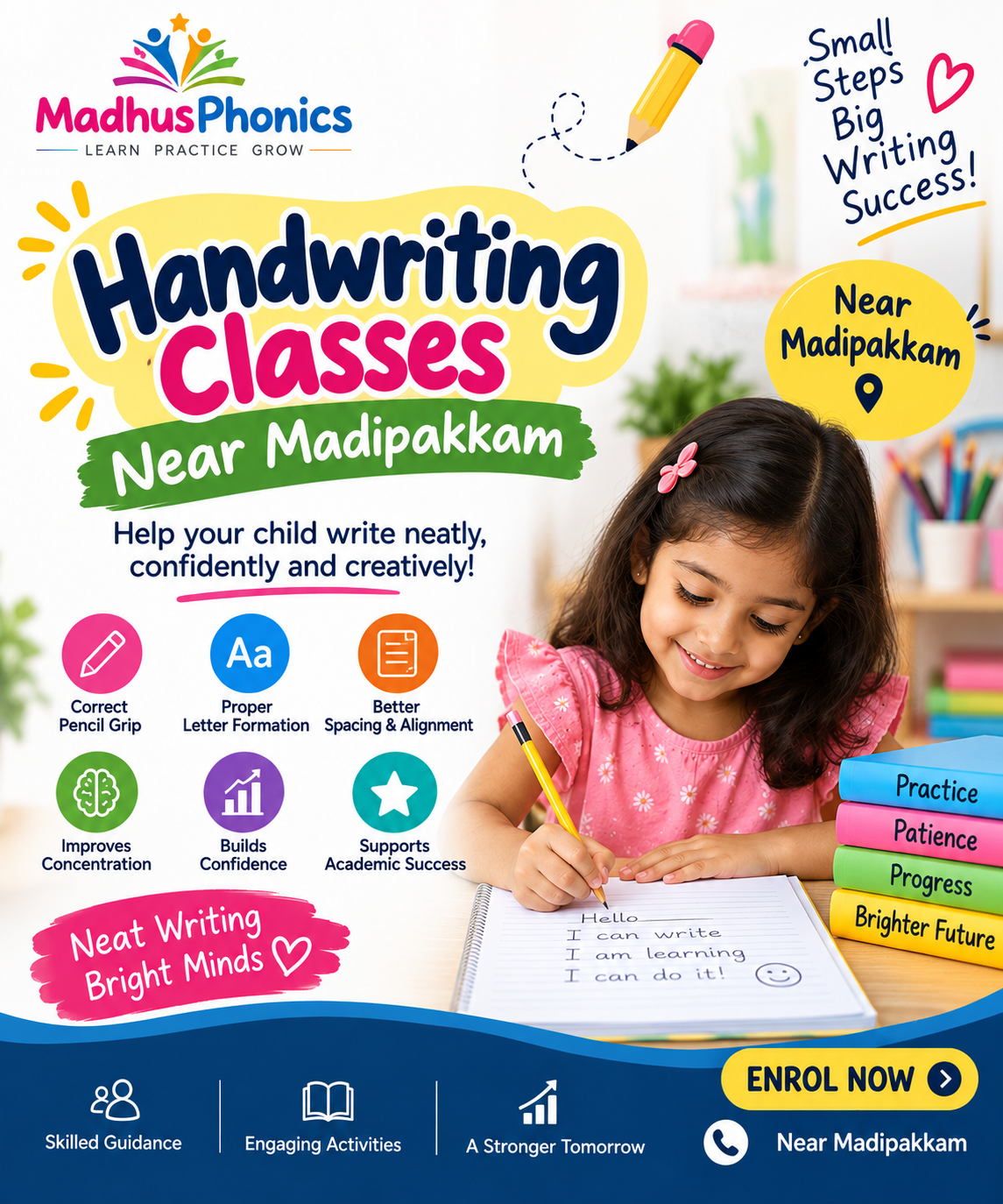
handwriting classes near madipakkam
Handwriting Classes Near Madipakkam Handwriting is one of the first important skills children learn when they begin their educational journey. From writing alphabets and numbers to completing school assignments, examinations, projects, and creative activities, children use handwriting every day. Developing good handwriting at an early age can make writing more comfortable, improve confidence, and help children present their schoolwork clearly. If you are searching for handwriting classes near Madipakkam, MadhusPhonics offers a supportive and engaging learning environment where children can practise and improve their handwriting skills step by step. Good handwriting is not achieved simply by asking children to write the same letters repeatedly. Children need to understand correct letter formation, pencil control, spacing, alignment, size, and writing movement. With structured guidance and consistent practice, children can gradually develop handwriting that is neat, readable, and comfortable. Why Is Handwriting Important for Children? Handwriting is closely connected with a child’s everyday learning experience. Although children today are increasingly exposed to digital devices, handwriting continues to play an important role in school education. Children write in notebooks, complete worksheets, take examinations, make notes, and submit assignments. When their handwriting is difficult to read or they struggle to write comfortably, it can sometimes affect their overall classroom experience. Good handwriting can help children: Write more clearly Complete written activities comfortably Develop better pencil control Maintain appropriate spacing Improve letter formation Organise written work Develop writing confidence Improve concentration during writing activities Present schoolwork neatly Develop better writing habits Handwriting classes provide children with an opportunity to focus specifically on these areas. Handwriting Classes Near Madipakkam for Children Parents in Madipakkam and nearby areas often look for educational classes that can complement their child’s regular school learning. Handwriting is one such skill that can benefit children throughout their academic years. At MadhusPhonics, handwriting activities are designed to make learning simple and enjoyable. Children can be introduced to writing concepts according to their individual learning level. A beginner may need more practice with basic strokes, curves, patterns, and alphabet formation. Another child may already know the alphabet but need support with spacing, alignment, consistency, or writing speed. The focus should always be on gradual improvement rather than comparing one child’s handwriting with another. What Do Children Learn in Handwriting Classes? Handwriting involves several different skills. Developing each of these skills can help children become more comfortable and confident writers. 1. Proper Pencil Grip Pencil grip is an important part of early handwriting development. Children need sufficient control over the pencil to create smooth strokes without applying unnecessary pressure. A comfortable grip can help reduce hand fatigue during writing. Handwriting activities can encourage children to develop better pencil control while practising different strokes and letter shapes. 2. Basic Writing Strokes Before writing complete letters, children benefit from understanding basic strokes. These can include: Straight lines Curved lines Slanting lines Loops Circles Waves Zigzag patterns Practising these movements can help children develop the coordination required for forming letters. 3. Correct Letter Formation One of the key objectives of handwriting practice is helping children form letters correctly. Children learn where to begin a letter, the direction of movement, and how the individual strokes come together. Consistent letter formation can make handwriting more readable and help children develop a natural writing rhythm. 4. Letter Size Children sometimes write letters in inconsistent sizes. One letter may be very large while another is extremely small. Handwriting practice helps children understand appropriate letter proportions and maintain consistency while writing words and sentences. 5. Proper Spacing Spacing is another important aspect of neat handwriting. Children need to understand the difference between spacing within letters, between letters, and between words. Appropriate spacing makes sentences easier to read and gives written work a more organised appearance. 6. Line Alignment Writing along the correct line can make a significant difference to handwriting presentation. Children learn how letters should sit on the writing line and how certain letters extend above or below it. With regular practice, maintaining alignment can become more natural. 7. Writing Speed and Fluency As children become comfortable with letter formation, they can gradually develop better writing fluency. The objective is not to make children write as quickly as possible. Instead, they should learn to write at a comfortable speed while maintaining clarity and consistency. How Handwriting Classes Can Build Confidence Children can sometimes become discouraged when they feel their handwriting is not as neat as they would like. They may hesitate to write on the board, complete assignments slowly, or avoid activities that involve a lot of writing. Regular handwriting practice can help children see their own progress. When a child notices that their letters are becoming clearer, their spacing is improving, or they can write a sentence more comfortably, it can create a sense of achievement. This gradual improvement can contribute to greater confidence in school-related writing activities. Handwriting and Fine Motor Development Writing requires controlled movements of the fingers, hands, and wrist. Children need to coordinate these movements while simultaneously looking at the letters or words they are writing. This is why handwriting practice can also support fine motor development. Activities involving tracing, patterns, colouring, drawing, and writing can encourage children to develop greater control over small hand movements. Better fine motor control can also be useful for activities such as: Drawing Colouring Craft work Cutting with scissors Using classroom tools Writing numbers Completing worksheets Other hands-on activities Handwriting therefore contributes to more than simply producing neat letters. Why Choose MadhusPhonics for Handwriting Classes Near Madipakkam? When choosing handwriting classes, parents often look for a place where children can learn without feeling pressured. MadhusPhonics focuses on creating a positive learning experience where children can practise, make mistakes, receive guidance, and improve gradually. A structured handwriting programme can help identify the areas where a child requires more practice. For some children, the focus may be pencil control. For others, it may be letter size, spacing, alignment, or writing consistency. By working on these areas step by step, children can develop stronger
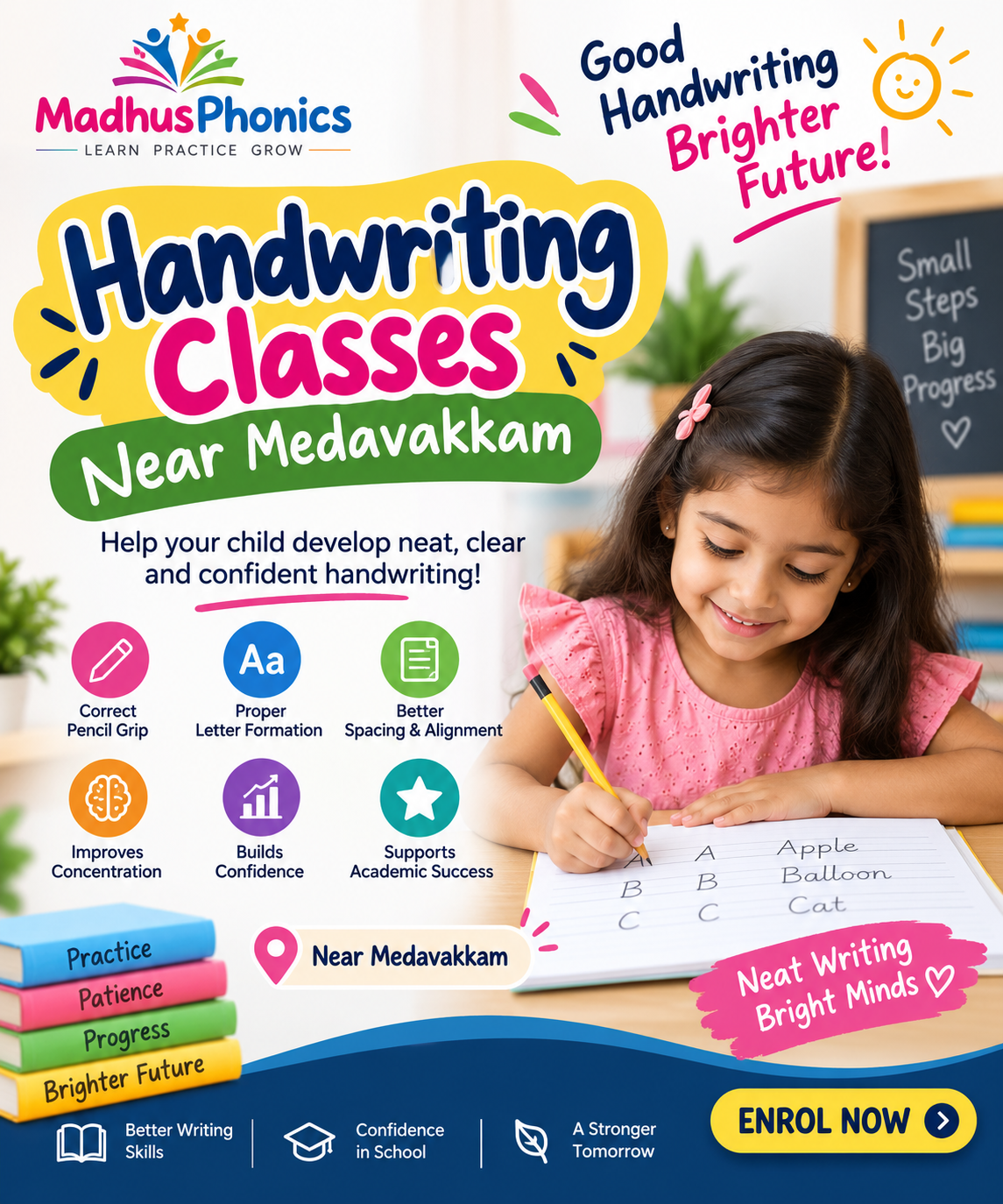
handwriting classes near medavakkam
Handwriting Classes Near Medavakkam Good handwriting is more than simply writing neatly on a piece of paper. For children, handwriting is an important foundation for learning, communication, creativity, and academic confidence. When children learn how to form letters correctly, maintain proper spacing, control pencil movements, and write comfortably, they become more confident in their classroom activities and everyday writing. If you are searching for handwriting classes near Medavakkam, MadhusPhonics offers a child-friendly learning environment designed to help children develop clear, legible, and confident handwriting skills. With the right guidance and regular practice, children can gradually improve their letter formation, writing speed, spacing, alignment, and overall presentation. Why Is Good Handwriting Important for Children? Children use handwriting throughout their school years. From writing alphabets and words to completing homework, examinations, projects, and classwork, handwriting plays an important role in their academic journey. Poor handwriting can sometimes make it difficult for teachers and parents to understand a child’s work. Children may also feel frustrated when they are unable to write as neatly or quickly as their classmates. Handwriting practice helps children develop several useful skills, including: Better pencil control Improved hand-eye coordination Proper letter formation Consistent letter size Correct spacing between words Better writing alignment Improved writing speed Increased concentration Greater confidence while writing Improved presentation of schoolwork A structured handwriting programme can make the learning process easier and more enjoyable for children. Handwriting Classes Near Medavakkam for Young Learners Parents living in Medavakkam and surrounding areas often look for activities that can support their children’s educational development. Handwriting classes can be a useful addition to a child’s learning routine because they focus on a skill that children use every day. At MadhusPhonics, handwriting learning can be approached in a simple and engaging manner. Instead of expecting children to improve through repetitive copying alone, children can be guided to understand how letters are formed and how pencil movements should be controlled. The objective is to help children develop a comfortable writing habit while gradually improving neatness and consistency. What Do Children Learn in Handwriting Classes? Handwriting development involves several small skills. Children need to learn each skill progressively before they can produce smooth and consistent handwriting. 1. Correct Pencil Grip The way a child holds a pencil can affect writing comfort and control. An incorrect grip may cause unnecessary pressure on the fingers and hand. Children can be guided to develop a comfortable pencil grip that allows them to move the pencil more naturally. 2. Letter Formation Correct letter formation is one of the most important parts of handwriting development. Children learn how individual letters are formed, including where to begin the letter, the direction of strokes, and how different strokes connect. Consistent practice helps children remember these patterns. 3. Letter Size and Proportion Children sometimes write letters in different sizes within the same word. This can make handwriting difficult to read. Handwriting practice helps children understand the difference between small letters, tall letters, and letters that extend below the writing line. 4. Spacing Between Words Proper spacing makes writing much easier to read. Children learn to maintain suitable spaces between words rather than writing everything too close together or leaving unusually large gaps. 5. Writing on the Line Maintaining proper alignment can significantly improve handwriting presentation. Children are encouraged to understand where letters should sit on the writing line and how certain letters extend above or below it. 6. Writing Fluency Once children become comfortable with letter formation, they can gradually work toward smoother and faster writing. The goal is not simply to make children write quickly. Instead, they should learn to write comfortably while maintaining readability and consistency. How Handwriting Classes Can Improve Academic Confidence Children spend a considerable amount of time writing at school. If they struggle with handwriting, even simple classroom activities can become stressful. For example, a child may know the answer to a question but take too long to write it. Another child may complete an assignment but feel unhappy because the handwriting does not look neat. Regular handwriting practice can help reduce these difficulties. As children notice improvements in their own writing, they may become more willing to participate in writing activities. This can contribute to greater confidence in completing homework, worksheets, school assignments, and examinations. Handwriting and Fine Motor Skills Handwriting is closely connected with fine motor development. Writing requires children to coordinate small movements of their fingers, hands, wrists, and arms. These movements need control and precision. Activities that involve tracing, writing patterns, forming letters, and practising words can encourage children to develop better control over these movements. Fine motor development can also support other activities such as: Drawing Colouring Cutting Craft activities Using classroom materials Completing worksheets Writing numbers and mathematical work This is why handwriting practice can be valuable beyond handwriting itself. Why Choose MadhusPhonics? Parents looking for handwriting classes near Medavakkam may want a learning centre where children can develop their skills in a supportive environment. MadhusPhonics focuses on making learning approachable and engaging for children. The learning process can be adapted according to a child’s existing writing ability, allowing children to practise the areas where they need additional support. A child who is just beginning to develop writing skills may need more attention toward basic strokes and letter formation. A child with existing writing experience may benefit from activities focused on neatness, spacing, consistency, and writing speed. The aim is to encourage steady improvement rather than expecting instant results. Who Can Join Handwriting Classes? Handwriting classes can be useful for children at different stages of their learning journey. They may benefit: Children learning to write alphabets Preschool and kindergarten children Primary school students Children who need better pencil control Children with inconsistent letter formation Children who struggle with spacing Children whose writing is difficult to read Children who want to improve writing presentation Students who want to develop better writing speed The right practice approach can vary depending on the child’s age, writing experience, and individual needs. Handwriting
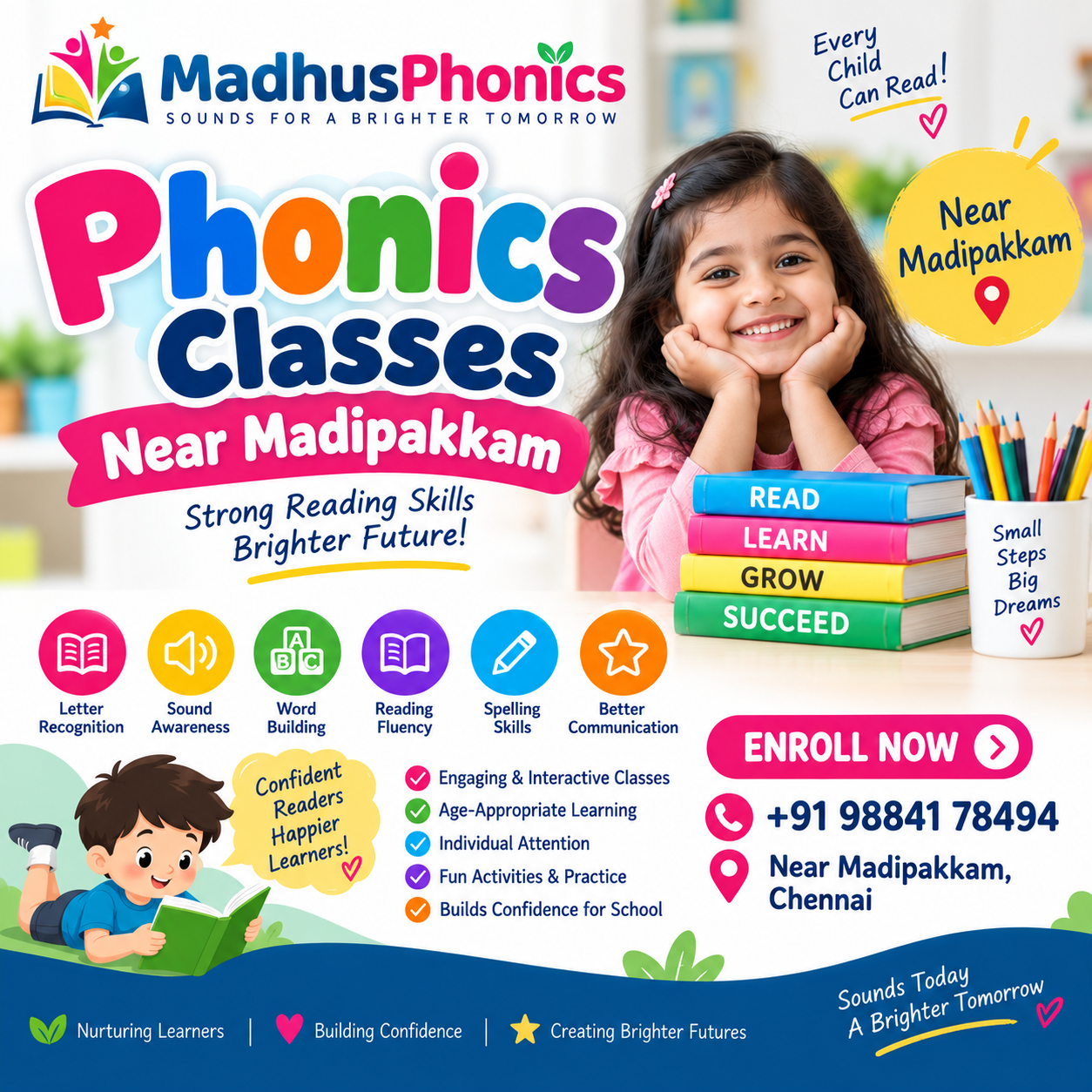
phonics classes near madipakkam
phonics classes near madipakkam Learning to read is an important milestone in every child’s educational journey. A strong foundation in English reading, pronunciation, spelling, and vocabulary can help children become confident learners both inside and outside the classroom. For parents searching for phonics classes near Madipakkam, finding a structured and child-friendly learning program can make a significant difference. MadhusPhonics provides phonics-based learning designed to help children understand letter sounds, blend sounds into words, improve reading fluency, develop spelling skills, and build confidence in English communication. Phonics is more than simply learning the alphabet. It teaches children how sounds work together to create words, giving them the skills they need to approach unfamiliar words independently. What Are Phonics Classes? Phonics classes teach children the relationship between letters and sounds. Children learn how individual letters and groups of letters represent different sounds and how these sounds can be combined to form words. For example, a child may learn the sounds represented by: C – /k/ A – /a/ T – /t/ By blending these sounds together, the child can read the word CAT. As children progress, they learn more complex sound patterns, including combinations such as sh, ch, th, ee, ai, oa, and many other phonics patterns. This systematic approach can make reading easier because children learn how to decode words rather than relying entirely on memorization. Why Are Phonics Classes Important for Children? Children encounter hundreds and eventually thousands of words during their school years. Memorizing every word individually would be difficult. Phonics gives children a set of skills that they can apply to many different words. A good phonics program can support: Letter-sound recognition Phonemic awareness Word blending Reading fluency Spelling Pronunciation Vocabulary development Listening skills Reading confidence Communication skills When children understand the sounds behind words, they can gradually become more independent readers. Looking for Phonics Classes Near Madipakkam? Parents searching for phonics classes near Madipakkam often want a learning program that combines effective teaching with an enjoyable environment. Children learn best when they are actively involved in the lesson. Instead of making phonics a repetitive memorization exercise, learning can include sounds, words, stories, activities, reading practice, and interactive exercises. MadhusPhonics focuses on creating a supportive learning environment where children can develop their phonics skills step by step. Whether your child is beginning to learn letter sounds or needs additional support with reading and spelling, a structured phonics program can help strengthen their foundation. How MadhusPhonics Supports Early Reading At MadhusPhonics, phonics learning follows a progressive approach. Children are introduced to foundational sounds and gradually move toward blending, word recognition, reading, spelling, and more advanced language skills. The learning journey can be broadly understood as: Sounds → Letters → Blending → Words → Sentences → Reading → Confidence This progression helps children understand how individual sounds contribute to complete words and sentences. The objective is to help children use their knowledge practically rather than simply memorize phonics rules. Benefits of Joining Phonics Classes Near Madipakkam 1. Develops Strong Reading Foundations Phonics provides children with important decoding skills. When children know how sounds correspond to letters, they can attempt to read words they have not encountered before. This can make reading less intimidating and more manageable. 2. Improves Pronunciation Correct pronunciation is an important part of effective communication. Phonics encourages children to listen carefully to sounds and understand how those sounds are produced within words. Regular practice can help children become more confident when reading words aloud. 3. Builds Better Spelling Skills Reading and spelling are closely connected. When children understand sound patterns, they can use those patterns when trying to spell words. Phonics can therefore complement spelling practice and help children develop a more systematic approach to written English. 4. Increases Reading Confidence A child who struggles to read may hesitate to participate in classroom activities. As children learn to decode words independently, they can become more comfortable reading aloud. Small improvements can lead to greater confidence over time. 5. Supports Vocabulary Development Reading exposes children to new words and expressions. As phonics skills improve, children can read more independently and encounter a wider range of vocabulary. A growing vocabulary can support reading comprehension, speaking, and writing. 6. Encourages Independent Learning One of the long-term benefits of phonics is that children can develop strategies for figuring out unfamiliar words. Instead of immediately asking someone to tell them a word, they can try sounding it out and blending the sounds. This encourages independent learning habits. Phonics Classes for Different Age Groups Children do not all learn at the same speed. Some children may recognize the alphabet early, while others may need additional practice before they are comfortable with letter sounds. A progressive phonics program can accommodate different learning stages. Early Learners Young learners can begin with: Alphabet recognition Basic letter sounds Listening activities Sound identification Simple vocabulary Beginning blending At this stage, keeping lessons engaging and interactive is especially important. Developing Readers Children who already know basic sounds can progress to: Blending sounds Reading simple words Digraphs Word families Short sentences Spelling practice Vocabulary building Advanced Learners Children with stronger phonics foundations can work on: Longer words Complex phonics patterns Reading fluency Pronunciation Spelling patterns Reading comprehension Vocabulary Confident communication This step-by-step approach allows children to build skills without rushing through important foundations. Why Choose MadhusPhonics? When parents search for the best phonics classes near Madipakkam, they should look beyond simply finding a convenient location. The teaching approach, learning environment, curriculum, regular practice, and suitability for the child’s level are all important. MadhusPhonics focuses on making phonics learning structured, engaging, and practical. The program aims to help children strengthen several connected skills: Phonics + Reading + Spelling + Vocabulary + Pronunciation + Communication This broader approach helps children understand that phonics is not just another class. It is a foundation that can support their overall English language development. Making Phonics Learning Fun Children naturally enjoy activities that involve interaction, discovery, and creativity. Phonics lessons can therefore be made more
phonics classes in madipakkam
Phonics Classes in Madipakkam Learning to read is one of the most important milestones in a child’s early education. When children understand how letters and sounds work together, they can read words more confidently, improve their pronunciation, and develop better communication skills. For parents looking for phonics classes in Madipakkam, choosing the right learning environment can make a meaningful difference in a child’s language development. MadhusPhonics offers structured and engaging phonics learning designed to help children develop essential reading, spelling, pronunciation, and vocabulary skills through systematic phonics education. Whether your child is just beginning to recognize letters or is ready to improve reading fluency, phonics training can provide a strong foundation for lifelong learning. What Is Phonics? Phonics is a method of teaching children how letters and combinations of letters represent sounds in spoken language. Instead of simply memorizing words, children learn to understand the relationship between letters, sounds, and words. For example, children can learn that: A can make the sound /a/ as in apple B makes the sound /b/ as in ball C can make the sound /k/ as in cat SH represents a specific sound as in ship CH represents a sound as in chair Once children understand these sound patterns, they can begin blending individual sounds to read complete words. This makes phonics an important part of early literacy development. Why Choose Phonics Classes in Madipakkam? Madipakkam is a growing residential area with many families looking for quality educational opportunities for their children. With school education becoming increasingly focused on English communication, reading ability, pronunciation, and vocabulary, parents are actively looking for effective learning programs outside regular classroom teaching. A well-structured phonics class in Madipakkam can give children additional practice and individual attention. Phonics classes can help children: Recognize letter sounds Blend sounds to form words Read unfamiliar words Improve pronunciation Develop spelling skills Expand vocabulary Improve reading confidence Develop listening skills Build better communication abilities Create a strong foundation for English learning How MadhusPhonics Helps Children Learn At MadhusPhonics, phonics learning is designed to be engaging, structured, and child-friendly. Young children learn differently from adults, so lessons should be interactive rather than based only on memorization. Children can learn through a combination of: Sound-based activities Letter recognition Word-building exercises Reading practice Interactive learning activities Vocabulary development Story-based learning Pronunciation exercises Repetition and reinforcement The objective is not simply to make children memorize a list of words. Instead, children are encouraged to understand the sound patterns behind words so that they can apply the same knowledge while reading new words. Benefits of Joining Phonics Classes 1. Better Reading Skills One of the biggest benefits of phonics education is improved reading ability. Children learn how to decode words by recognizing individual sounds and blending them together. For example, when a child learns the sounds represented by C – A – T, they can blend those sounds to read the word cat. With consistent practice, children can gradually become more independent readers. 2. Improved Pronunciation Correct pronunciation is an important part of effective communication. Phonics helps children understand how individual letters and letter combinations produce sounds. Regular practice can help children become more aware of sounds and pronounce words more clearly. 3. Stronger Spelling Skills Phonics does not only help children read. It can also support spelling development. When children understand sound patterns, they can use those patterns when attempting to spell unfamiliar words. This helps them move beyond simple word memorization. 4. Increased Vocabulary Reading regularly exposes children to new words. As their decoding ability improves, they can read more books and discover new vocabulary. A larger vocabulary can support better speaking, writing, and comprehension skills. 5. Greater Confidence Some children hesitate to read aloud because they are worried about making mistakes. A supportive learning environment can help them practice without fear. As children begin recognizing words independently, their confidence can gradually improve. 6. Better Listening and Sound Awareness Phonics encourages children to listen carefully to individual sounds within words. This develops phonemic awareness, which is an important foundation for reading and spelling. Phonics Classes for Different Learning Levels Every child develops at a different pace. Some children may already recognize letters and basic sounds, while others may need more introductory practice. A good phonics program can therefore be adapted according to the learner’s current level. Beginner Level Beginner learners can focus on: Alphabet recognition Basic letter sounds Sound identification Simple vocabulary Beginning blending Short words Intermediate Level Children with basic phonics knowledge can progress toward: More complex sound patterns Digraphs Blending longer words Reading sentences Spelling practice Vocabulary development Advanced Level Advanced learners can work on: Complex words Reading fluency Advanced spelling patterns Pronunciation Reading comprehension Vocabulary Confident communication This progressive approach allows children to strengthen their skills step by step. Why Early Phonics Education Matters The early years are an important period for developing language and literacy skills. Children are naturally curious about sounds, words, stories, and communication. Introducing phonics at an appropriate age can help them understand that spoken words are made up of sounds and that those sounds can be represented using letters. Once children understand this relationship, reading can become more logical and less dependent on memorization. Early phonics education can therefore support children as they progress through school and encounter increasingly complex vocabulary. Phonics and School Learning Parents often ask whether phonics classes are useful alongside regular school education. Phonics training can complement classroom learning by giving children additional opportunities to practice reading and sound recognition. Children may encounter many new words in school textbooks, worksheets, stories, and classroom activities. Strong phonics skills can help them approach these words with greater confidence. Rather than immediately asking an adult for help, a child who understands phonics may be able to attempt decoding a new word independently. This independent learning habit can become valuable as academic requirements increase. What Parents Should Look for in Phonics Classes When searching for the best phonics classes in Madipakkam, parents can consider several factors. Structured Learning
phonics classes in medavakkam
Phonics Classes in Medavakkam Learning to read is one of the most important milestones in a child’s early education. When children understand how letters and sounds work together, they can read words with greater confidence and develop a strong foundation for future learning. For parents looking for phonics classes in Medavakkam, MadhusPhonics offers a structured and child-friendly approach to developing early reading, pronunciation, spelling, and communication skills. Phonics is more than simply teaching children the alphabet. It helps children understand the relationship between letters and their sounds, allowing them to decode unfamiliar words instead of depending entirely on memorisation. With regular practice and engaging activities, children can gradually become confident and independent readers. Why Choose Phonics Classes in Medavakkam? Medavakkam is a rapidly developing residential area with many families looking for quality educational programs for their children. Early literacy is an important part of a child’s academic development, and phonics can make the process of learning to read more systematic and enjoyable. Traditional methods may encourage children to memorise words, while phonics focuses on understanding the sounds within words. Once children learn common sound patterns, they can apply those skills to new words. A good phonics program can help children: Recognise letters and their corresponding sounds Blend individual sounds to read words Break words into individual sounds Improve pronunciation Develop spelling skills Expand vocabulary Improve reading fluency Build confidence in English Develop better listening skills Create a positive attitude towards reading For parents searching online for phonics classes near Medavakkam, choosing a program that combines structured learning with fun activities can make a significant difference. What Is Phonics? Phonics is a method of teaching reading by helping children understand the connection between written letters and spoken sounds. For example, children may learn that the letter “m” represents the /m/ sound. They can then combine sounds to read simple words. A child might learn: c + a + t = cat Instead of memorising the word “cat” as a whole, the child learns how the individual sounds combine to form the word. As children progress, they learn more complex sound combinations, blending techniques, vowel sounds, consonant sounds, digraphs, word families, and other important reading patterns. This systematic approach can help children develop decoding skills that they can use when they encounter new words. MadhusPhonics – Phonics Classes in Medavakkam At MadhusPhonics, the focus is on creating a supportive learning environment where children can develop their reading skills step by step. The objective is not simply to make children repeat sounds. Instead, children are encouraged to understand sounds, practise them, combine them, and use them while reading and spelling. Our phonics learning approach can include: 1. Letter Sound Recognition Children are introduced to the sounds associated with letters in an age-appropriate way. Repeated exposure and practice help children become familiar with individual sounds. 2. Sound Blending Blending is an important phonics skill. Children learn to combine individual sounds to form complete words. For example: s – u – n → sun With practice, children gradually become more comfortable reading words independently. 3. Segmenting Segmenting teaches children to break words into individual sounds. This is particularly useful for spelling and writing. For example: fish → f – i – sh Children learn to listen carefully to the sounds within words. 4. Vocabulary Development Phonics activities can be combined with vocabulary-building exercises. Children encounter new words while practising sounds and reading. A growing vocabulary supports both reading comprehension and communication. 5. Reading Practice Children need opportunities to apply what they learn. Reading practice allows them to use phonics knowledge in real words and simple sentences. Gradually, children can develop greater reading fluency and confidence. Benefits of Learning Phonics at an Early Age Early literacy skills can influence a child’s overall learning experience. When children have difficulty reading basic words, they may find other subjects more challenging as they progress through school. Phonics provides children with tools that can support their reading development. Better Reading Confidence Children often feel more confident when they understand how to approach unfamiliar words. Phonics gives them a strategy rather than requiring them to guess every new word. Stronger Spelling Skills Phonics and spelling are closely connected. Understanding sounds can help children identify the sounds they need when attempting to spell unfamiliar words. Improved Pronunciation Regular sound practice can help children become more aware of pronunciation and the differences between similar sounds. Independent Learning As children develop decoding skills, they can begin attempting words independently. This can encourage curiosity and a stronger interest in books and reading. Better Communication Reading, vocabulary, listening, and pronunciation work together. A strong early literacy foundation can support children’s overall English communication skills. Why Parents Prefer Structured Phonics Learning Every child learns differently. Some children may quickly recognise letters and sounds, while others require additional repetition and practice. A structured phonics program allows learning to progress from simple concepts to more advanced reading patterns. Instead of introducing too many concepts at once, children can gradually build their skills. A typical progression may include: Letters → Letter Sounds → Blending → Simple Words → Digraphs → Word Families → Sentences → Reading Fluency This step-by-step approach can make learning more manageable for young children. Fun and Engaging Phonics Activities Children learn effectively when they are actively involved in the learning process. Phonics lessons can therefore include interactive activities rather than relying only on worksheets. Depending on the child’s learning stage, activities may include: Sound recognition games Letter identification activities Picture and sound matching Word-building exercises Reading cards Rhyming activities Story-based learning Flashcards Blending games Spelling activities Interactive reading exercises Making learning enjoyable can help children remain engaged and develop a positive relationship with reading. Phonics Classes for Young Learners Early childhood is an excellent stage for developing foundational language and literacy skills. However, the ideal starting age can vary depending on the individual child. Some children may begin recognising letters and sounds at an early age, while others may need more time. The important thing