
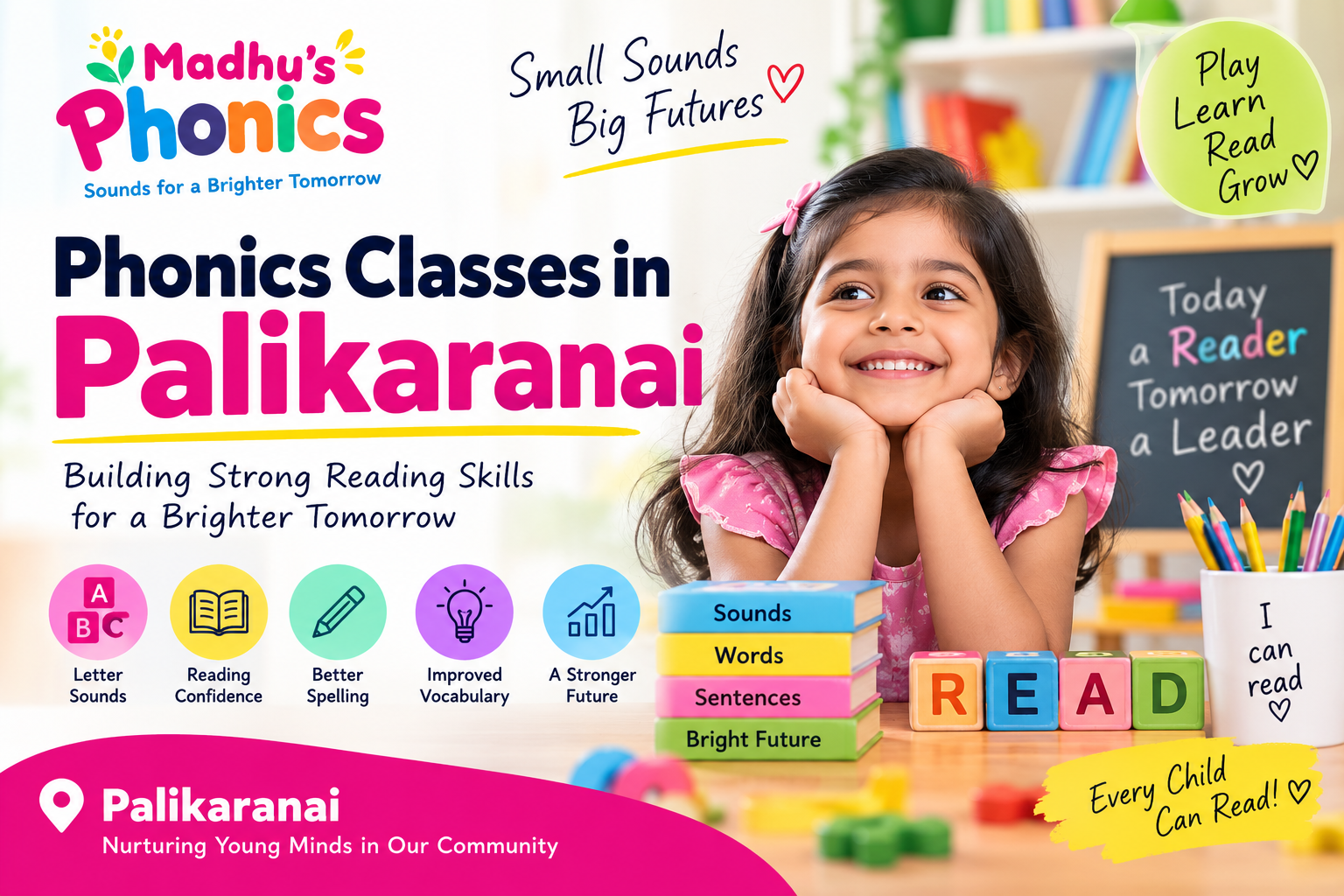
Phonics Classes in Pallikaranai
Learning to read is one of the most important steps in a child’s early education. When children develop strong reading skills at a young age, they often become more confident in communication, vocabulary, spelling, writing, and classroom learning. However, learning English can sometimes be challenging for young children because English letters can represent different sounds in different words.
This is where phonics can make a meaningful difference.
If you are a parent looking for phonics classes in Pallikaranai, choosing a structured and child-friendly learning program can help your child develop a strong foundation in English. Madhu’s Phonics focuses on making phonics learning engaging, systematic, and enjoyable so that children can gradually develop the skills they need to read and spell with confidence.
From identifying individual letter sounds to blending sounds into complete words, phonics gives children practical tools that they can use throughout their reading journey.
What Is Phonics?
Phonics is a method of teaching children how letters and sounds are connected.
For example, children learn that the letter “b” represents the /b/ sound in words such as “bat,” “ball,” and “bus.” They then learn to combine different sounds to form words.
Consider the word:
C – A – T
When a child learns the individual sounds and understands how to blend them, they can read the word “cat.”
This approach gives children a strategy for approaching new words rather than requiring them to memorize every word individually.
Phonics programs may cover:
Letter and sound recognition
Vowel sounds
Consonant sounds
Sound blending
Word segmentation
Rhyming words
Digraphs
Trigraphs
Word families
Spelling patterns
Reading sentences
Pronunciation practice
A well-planned phonics program gradually introduces these concepts according to the child’s learning level.
Why Are Phonics Classes Important for Young Children?
Young children are naturally curious about language. They listen to sounds, repeat words, ask questions, and try to communicate with people around them.
Phonics can build on this natural curiosity by helping children understand how spoken sounds are represented in written English.
When children understand these relationships, they can begin to decode words independently.
For example, if a child knows the sounds represented by s, a, and t, they can combine those sounds to read “sat.” Once they understand similar patterns, they can begin reading more words.
This creates a gradual progression:
Sounds → Letters → Words → Sentences → Reading
That progression can provide children with a strong foundation for future literacy development.
Phonics Classes in Pallikaranai for Better Early Literacy
Parents searching for phonics classes in Palikaranai often want more than simple alphabet lessons. They want their children to understand how English sounds work and develop practical reading skills.
At Madhu’s Phonics, the learning process can focus on building these skills step by step.
Instead of rushing children through difficult concepts, phonics learning can be introduced through age-appropriate activities. Children can listen to sounds, identify letters, blend sounds, build words, and practice reading.
The goal is to help children understand what they are learning rather than simply repeat information.
Developing Reading Confidence
Confidence is an important part of early learning.
A child who struggles with reading may hesitate to read aloud or participate in classroom activities. On the other hand, when children experience small successes, they may become more willing to attempt new words.
Phonics provides children with a method for decoding unfamiliar words.
Instead of immediately asking, “What is this word?”, children can learn to look at the letters, identify the sounds, and try blending them.
This sense of independence can be extremely valuable.
When a child successfully reads a new word, it can create a positive learning experience. Repeated experiences like this can gradually strengthen reading confidence.
Learning Through Fun and Interactive Activities
Children learn differently from adults. Long explanations and repetitive exercises may not always hold their attention.
That is why interactive learning can be particularly useful for young learners.
Phonics activities can include:
Sound Games
Children can listen to different sounds and identify the corresponding letters.
Picture Activities
Pictures can help children connect sounds and words with familiar objects.
Word-Building Exercises
Children can use letters to create simple words and understand how changing one sound can create a different word.
Rhyming Activities
Rhyming words can help children recognize sound patterns and develop phonological awareness.
Story-Based Learning
Simple stories can introduce new vocabulary while giving children opportunities to practice reading.
Flashcards and Matching Games
These activities can reinforce letter-sound recognition in an enjoyable way.
Making learning interactive can help children remain engaged while repeatedly practicing important skills.
Phonics and Spelling Skills
Phonics can also play an important role in spelling development.
When children learn to identify individual sounds within words, they begin to understand how those sounds can be represented using letters.
For example, when spelling a simple word, a child can listen carefully to the sounds and identify the letters needed to represent them.
This process is called segmenting.
Reading generally involves blending sounds together, while spelling often requires breaking words into individual sounds.
Therefore, phonics can support both reading and spelling development.
Improving Pronunciation Through Phonics
Pronunciation is another important benefit of learning sounds correctly.
Children may encounter English sounds that are unfamiliar to them. Regular exposure to sounds and repeated speaking practice can help them become more comfortable with English pronunciation.
Phonics encourages children to pay attention to the sounds within words.
This awareness can support clearer pronunciation and better listening skills.
The combination of listening, speaking, reading, and repetition creates a more complete language-learning experience.
Phonics Can Help Expand Vocabulary
As children become better readers, they can explore more books and encounter more vocabulary.
A child who has strong decoding skills can attempt to read unfamiliar words instead of avoiding them.
For example, while reading a story, a child may encounter a new word. By using phonics knowledge, the child can break the word into smaller sound units and attempt to pronounce it.
Once the word has been decoded, its meaning can be explained through the story or by a teacher or parent.
Over time, regular reading can expose children to a wider range of words and expressions.
The Role of Parents in Phonics Learning
Parents play an important role in supporting children’s learning outside the classroom.
You do not need complicated materials to practice phonics at home. Everyday activities can become learning opportunities.
Parents can:
Read storybooks with their children.
Ask children to identify beginning sounds.
Practice simple words.
Encourage children to sound out unfamiliar words.
Play rhyming games.
Look for letters and words around the house.
Encourage children to read short sentences.
Celebrate small improvements.
The most important thing is to make practice enjoyable.
Children should feel that reading is an exciting activity rather than a stressful assignment.
Even a few minutes of consistent practice can help reinforce concepts learned during phonics classes.
Why Choose Madhu’s Phonics?
Choosing the right learning environment can make a difference in how children experience phonics.
Madhu’s Phonics aims to create an engaging and supportive environment where children can explore English sounds and develop early reading skills.
A structured phonics approach can help children progress from basic sound recognition to word reading and eventually sentence-level reading.
The focus can include:
Strong phonics fundamentals
Reading readiness
Sound recognition
Blending and segmenting
Vocabulary development
Spelling awareness
Pronunciation practice
Reading confidence
Interactive learning
The objective is to make learning meaningful for children while giving parents confidence that their children are developing important literacy skills.
Who Can Benefit from Phonics Classes?
Phonics can benefit children at different stages of their early education.
It can be particularly useful for:
Children beginning their reading journey
Preschool learners
Kindergarten children
Early primary school students
Children who need additional reading practice
Children who want to improve spelling
Young learners developing English vocabulary
The appropriate teaching method and level may vary depending on the child’s age and existing skills.
How Phonics Builds Independent Readers
One of the most valuable outcomes of phonics learning is independence.
Children who understand sound-letter relationships have a method they can use when they encounter unfamiliar words.
Instead of relying completely on adults, they can attempt to decode words themselves.
This skill can become increasingly useful as reading materials become more complex.
A child who begins with simple words may eventually progress toward sentences, short stories, and longer books.
The journey happens gradually, but every new sound, word, and sentence contributes to a stronger reading foundation.
Choosing Phonics Classes in Palikaranai
When selecting phonics classes in Palikaranai, parents can consider several factors.
Look for a program that provides:
Structured learning – Concepts should be introduced progressively.
Interactive activities – Children should have opportunities to learn through participation.
Regular practice – Repetition helps reinforce new concepts.
Reading opportunities – Children should apply phonics knowledge to actual words and sentences.
Positive encouragement – Children should feel comfortable making mistakes and trying again.
Age-appropriate teaching – Activities should match the child’s learning stage.
Parent support – Parents should understand how they can reinforce learning at home.
A good phonics program should help children develop skills while maintaining their interest and curiosity.
Start Your Child’s Reading Journey with Madhu’s Phonics
Every child’s learning journey is different. Some children may recognize letters quickly, while others may need more repetition and encouragement. What matters is providing them with the right foundation and allowing them to progress step by step.
Phonics can make English reading more understandable by showing children how sounds and letters work together.
If you are looking for phonics classes in Palikaranai, Madhu’s Phonics can be a valuable option for building early literacy skills through structured and engaging learning.
The journey begins with simple sounds. Those sounds become letters. Letters become words. Words become sentences. And eventually, those sentences open the door to stories, knowledge, imagination, and lifelong learning.
Conclusion
Strong reading skills begin with a strong foundation.
Phonics helps children understand the connection between sounds and written letters, making it easier for them to decode words, improve spelling, develop vocabulary, and become confident readers.
For parents searching for phonics classes in Palikaranai, choosing an engaging and structured learning program can give children a positive start to their English learning journey.
Madhu’s Phonics focuses on helping young learners discover the world of sounds and words in an enjoyable and supportive environment.
Give your child the opportunity to learn, explore, read, and grow with confidence.
Madhu’s Phonics – Building Strong Readers, One Sound at a Time.